
Category: Separation Agreement
Abuse during Separation: What to Do When Threats Continue After Moving Out

How to Draft a Fair and Binding Separation Agreement?

Legal Requirements for a Binding Separation Agreement
Written Format and Signatures of Both Parties
A verbal agreement will not hold up in court. The separation agreement must be in writing, clearly outlining all terms in plain and unambiguous language. Both parties must sign the document, and it must be witnessed to ensure authenticity. Without these formalities, the agreement risks being deemed invalid.
Full Financial Disclosure Obligations
Transparency is critical when drafting a separation agreement. Failing to disclose material facts may lead to the agreement being set aside by the court, as it could be considered unfair or obtained under false pretences.
Independent Legal Advice for Both Parties
Ontario law strongly recommends—and in practice, requires for enforceability—that both parties obtain independent legal advice (ILA) before signing. A lawyer will review the terms, explain potential risks, and confirm the client is entering the agreement voluntarily.
Absence of Coercion, Duress, or Undue Influence
The agreement must be entered into freely. If one party can prove they were pressured, threatened, or manipulated into signing, a court may set aside the agreement.
Ensuring Fairness in the Agreement
A separation agreement in Ontario should not only meet the legal requirements for validity but also be balanced and reasonable. Courts are more likely to uphold an agreement when it reflects fairness to both parties and aligns with the principles of Ontario family law.
Balancing Both Parties’ Interests
A fair separation agreement addresses the needs and rights of both individuals. This includes equitable division of property, reasonable spousal support arrangements, and balanced parenting schedules. An agreement heavily favouring one party over the other is more vulnerable to being challenged in court.
Using Current Financial Information
To ensure the terms are accurate and fair, both parties should base the agreement on up-to-date financial information. Outdated or incomplete financial details can lead to disputes and possible invalidation of the agreement.
Considering the Best Interests of Children in Parenting Arrangements
When children are involved, the best interests of the child must always take priority. This means creating parenting arrangements that foster stability, maintain strong relationships with both parents, and support the child’s emotional and physical well-being. Ontario courts will not enforce clauses that undermine these principles.
Avoiding One-Sided or Unconscionable Terms
Clauses that are excessively harsh, one-sided, or contrary to Ontario’s public policy may be struck down. For example, waiving all spousal support without proper consideration of one spouse’s financial situation could be deemed unconscionable. Both parties should work towards terms that are reasonable, proportionate, and sustainable in the long term.
Key Clauses to Include in a Separation Agreement
A well-drafted separation agreement should cover all major aspects of the separation to prevent future disputes. In Ontario, including the right clauses ensures clarity, fairness, and enforceability.
Property Division – Assets, Debts, Pensions, Matrimonial Home
Your agreement should clearly outline how family property will be divided, including assets, debts, and pensions. The matrimonial home receives special treatment under Ontario law—both spouses have equal rights to possess it, regardless of whose name is on the title. The agreement should specify whether the home will be sold, transferred, or retained by one party, along with timelines and payment arrangements.
Spousal Support – Eligibility, Amount, and Duration
Include detailed provisions on spousal support, addressing eligibility based on income differences, length of the relationship, and roles during the marriage. Clearly state the support amount, payment frequency, and duration. You may also specify review dates or conditions under which support ends, such as remarriage or significant income changes.
Child Support and Parenting – Custody, Access, and Expenses
When children are involved, your agreement must include parenting arrangements and child support provisions consistent with the Child Support Guidelines in Ontario. Outline decision-making responsibilities (formerly called custody), parenting time schedules, and how expenses such as education, healthcare, and extracurricular activities will be shared.
Dispute Resolution Clause – Mediation or Arbitration Process
To avoid costly and lengthy court battles, include a dispute resolution clause. This can require both parties to attempt mediation or arbitration before pursuing court action, ensuring conflicts are resolved more efficiently and amicably.
Modification Terms – How the Agreement Can Be Changed in the Future
Circumstances may change after separation. Include a clause outlining how the agreement can be reviewed or modified, whether through mutual written consent, a set review date, or upon specific life events such as a change in income or relocation.
Common Mistakes to Avoid When Drafting
Even when both parties have good intentions, certain drafting errors can weaken a separation agreement or make it unenforceable under Ontario law. Avoiding these mistakes can help ensure the agreement stands the test of time.
Failing to Provide Full Disclosure
Omitting assets, debts, or income details can result in the agreement being set aside by a court. Ontario law requires complete and honest financial disclosure to ensure fairness. If one party later discovers undisclosed information, it can lead to legal challenges and additional costs.
Using Vague or Unclear Language
Ambiguity in terms—such as saying “reasonable parenting time” without defining a schedule—can cause disputes later. Use clear, specific wording for all clauses to avoid multiple interpretations. Precision is key when describing responsibilities, timelines, and payment amounts.
Ignoring Future Contingencies (Job Loss, Relocation)
Life circumstances change. Without clauses addressing possible future events like job loss, disability, or relocation, you may face unnecessary conflict or the need for a complete renegotiation. Including contingency provisions can make the agreement more adaptable and durable.
Not Having the Agreement Reviewed by a Lawyer
Skipping independent legal advice (ILA) is one of the most common and serious mistakes. Without a lawyer’s review, you risk signing terms that are unfair, unenforceable, or inconsistent with Ontario law. A lawyer can also ensure you understand your rights and obligations before committing.
The Role of Lawyers in Drafting a Separation Agreement
While it is possible for spouses to prepare a separation agreement on their own, involving a lawyer ensures the document is both legally sound and tailored to your specific situation. In Ontario, legal guidance is one of the best safeguards against future disputes or invalidation.
Reviewing for Compliance with Ontario Law
A lawyer will ensure that the terms of the agreement comply with the Family Law Act and other relevant Ontario legislation. This includes verifying that property division, spousal support, and child-related clauses meet statutory requirements and do not conflict with public policy.
Identifying Potential Problem Clauses
An experienced family lawyer can flag clauses that may cause issues later—such as vague parenting provisions, unclear timelines, or overly restrictive conditions. By addressing these concerns early, you reduce the risk of the agreement being challenged in court.
Ensuring Enforceability in Family Court if Necessary
If enforcement becomes necessary, a properly drafted and executed agreement will carry significant weight in family court. Lawyers ensure the document meets all procedural and substantive requirements, increasing the likelihood that it will be upheld if one party fails to comply.
How to Prepare a Separation Agreement for an Uncontested Divorce in Ontario

Understanding Separation Agreements in Ontario
What is a Separation Agreement?
A separation agreement is a legally binding document that outlines the terms of a couple’s separation. It serves as a mutual contract between spouses, addressing issues such as:
- Division of assets and debts
- Child custody and parenting arrangements
- Spousal and child support
- Use of the matrimonial home
While it is not required by law to have a separation agreement before filing for divorce, it is highly recommended as it provides clarity and prevents future disputes.
Separation Agreement vs. Divorce Decree
Many people confuse a separation agreement with a divorce decree, but they are fundamentally different.
- Separation Agreement: A private contract that outlines the terms of separation. It does not legally end the marriage.
- Divorce Decree: A court-issued order that officially terminates the marriage.
In Ontario, spouses must be separated for at least one year before they can file for an uncontested divorce. Having a separation agreement in place can simplify the process by ensuring both parties agree on major issues.
Legal Requirements Under the Ontario Family Law Act
For a separation agreement to be legally enforceable in Ontario, it must comply with Part IV of the Family Law Act and meet the following requirements:
- Full Financial Disclosure – Each spouse must provide complete and honest financial information, including income, debts, and assets.
- Voluntary Agreement – The agreement must be signed willingly, without coercion or pressure.
- Independent Legal Advice (ILA) – It is recommended that both parties seek their own Toronto divorce lawyer to review the agreement before signing. This helps protect individual rights and ensures fairness.
- Written and Signed Document – A verbal agreement is not legally enforceable. The document must be in writing and signed by both spouses in the presence of a witness.
Key Elements of a Separation Agreement
Division of Property and Debts
The division of assets and debts is one of the most critical aspects of a separation agreement. In Ontario, the equalization of net family property (NFP) ensures a fair division, taking into account the assets each spouse accumulated during the marriage.
- How to Fairly Divide Assets and Liabilities
-
- Both parties must disclose all assets and debts honestly.
- Assets such as homes, vehicles, investments, and savings accounts should be assessed at fair market value.
- Any assets owned before the marriage are generally excluded, except for the matrimonial home, which is always subject to division.
- Handling Joint Mortgages, Loans, and Pensions
-
- If spouses jointly own a home, they must decide whether one party will keep it (through a buyout) or if it will be sold and the proceeds split.
- Joint credit cards, loans, and lines of credit must be divided or refinanced in one spouse’s name to avoid future financial disputes.
- Pensions and retirement savings are subject to division based on the Ontario Pension Benefits Act and family law principles.
Spousal Support
Spousal support is not automatically granted in every separation. It depends on factors such as the length of the marriage, each spouse’s financial situation, and contributions to the relationship.
- When Spousal Support is Required and How It Is Calculated
-
- Ontario follows the Spousal Support Advisory Guidelines (SSAG) to determine the appropriate amount and duration of support.
- Support may be compensatory (to offset financial sacrifices made by one spouse) or non-compensatory (to provide basic financial support if one spouse is economically disadvantaged).
- Legal Rights and Obligations Under Ontario Law
-
- Spousal support agreements must consider tax implications, as payments are typically taxable for the recipient and tax-deductible for the payor.
- If there is a significant change in financial circumstances, the agreement should outline the process for requesting modifications.
Child Custody and Parenting Arrangements
When children are involved, a clear parenting plan must be included in the separation agreement to ensure their well-being.
- How Ontario Courts Prioritize the Child’s Best Interests
-
- The Divorce Act and Children’s Law Reform Act (CLRA) state that the child’s best interests are the top priority when determining custody.
- Factors considered include emotional bonds with each parent, stability, and each parent’s ability to provide for the child’s needs.
- Creating a Clear Parenting Plan
-
- A detailed plan should specify:
- Legal decision-making responsibilities (formerly called custody).
- Parenting time schedules, including holidays and vacations.
- Communication methods for co-parenting (e.g., email, co-parenting apps).
- A detailed plan should specify:
Child Support
Child support is a legal obligation and must comply with Ontario’s Child Support Guidelines under the Federal Child Support Tables.
- Calculating Child Support Based on Ontario’s Child Support Guidelines
-
- The amount is based on the paying parent’s gross annual income and the number of children.
- If one parent earns a significantly higher income, additional section 7 expenses (such as daycare, medical costs, or extracurricular activities) may be included.
- Adjustments for Shared Parenting Responsibilities
-
- In cases of shared custody (50/50 time-sharing), the courts consider both parents’ incomes and may adjust payments accordingly.
- Agreements should outline how future changes in income or parenting arrangements will be handled.
Other Considerations
Beyond financial and parenting matters, a separation agreement can include additional provisions to prevent future conflicts.
- Life Insurance and Beneficiary Designations
-
- Many agreements require the paying spouse to maintain a life insurance policy with the other spouse or children as beneficiaries to secure financial obligations.
- Future Dispute Resolution Methods
-
- A clause should specify how disputes will be resolved, such as through mediation, arbitration, or court intervention.
- This helps avoid costly legal battles in the future and promotes amicable resolutions.
By addressing these key elements, couples can create a comprehensive and legally sound separation agreement, paving the way for a smooth uncontested divorce in Ontario. Seeking independent legal advice before finalizing the agreement is always recommended to ensure fairness and legal compliance.
Steps to Preparing a Separation Agreement
Step 1: Gathering Financial Information
Before drafting a separation agreement, both spouses must provide full financial disclosure. Transparency ensures a fair division of assets and prevents legal complications.
Importance of Full Financial Disclosure (Income, Assets, Debts)
- Both parties must disclose:
- Income (employment, rental income, business earnings, government benefits).
- Assets (bank accounts, investments, properties, vehicles, pensions, RRSPs).
- Debts (mortgages, credit card balances, personal loans, lines of credit).
- Full financial disclosure ensures fairness in property division, spousal support, and child support calculations.
How Undisclosed Financial Information Can Lead to Legal Challenges
- If a spouse fails to disclose financial details, the other party may challenge the agreement in court.
- Ontario courts may invalidate the agreement if it is found to be unfair due to hidden assets.
- A spouse who withholds financial information may face legal consequences, including the reopening of property division cases.
Step 2: Discussing Terms with Your Spouse
Effective communication is key to reaching an agreement without unnecessary conflict.
Effective Communication Strategies for Reaching an Agreement
- Stay focused on practical matters rather than emotional conflicts.
- Use written communication if in-person discussions become difficult.
- Be open to compromise on financial and parenting matters.
- Keep discussions structured, focusing on legal and financial fairness rather than personal grievances.
If direct discussions are unproductive, spouses may need professional assistance.
Using Mediation or Collaborative Family Law If Needed
- Mediation: A neutral third-party mediator helps both spouses negotiate a fair agreement.
- Collaborative Family Law: Each spouse hires a lawyer trained in conflict resolution to facilitate negotiations.
- Advantages:
- Avoids court involvement and reduces legal costs.
- Helps both parties reach a mutually beneficial arrangement.
- Encourages cooperation, especially if children are involved.
If mediation fails, the next step is consulting family lawyers to ensure legal compliance.
Step 3: Drafting the Agreement
Once both parties have reached an understanding on key issues, the agreement must be drafted in clear and legally precise terms.
Using Clear, Legally Sound Language to Prevent Ambiguity
- Avoid vague wording such as “reasonable parenting time” or “fair division of assets.”
- Specify financial obligations with clear figures and deadlines.
- Include contingency plans for future financial or parenting changes.
A properly drafted agreement prevents misinterpretation and future disputes.
Ensuring Compliance with Ontario Family Law
- The separation agreement must comply with Ontario’s Family Law Act.
- Any provisions related to child support, parenting arrangements, or spousal support must align with:
- Ontario’s Child Support Guidelines
- The Divorce Act and Children’s Law Reform Act
- Spousal Support Advisory Guidelines (SSAG)
- If the agreement contradicts legal requirements (e.g., waiving child support), courts may invalidate those sections.
Seeking legal review at this stage ensures compliance and protects both spouses from future legal issues.
Step 4: Seeking Independent Legal Advice (ILA)
Even if both spouses agree on all terms, they should still consult separate lawyers before signing.
- Why Both Parties Should Consult Separate Lawyers
-
- Lawyers review the agreement to ensure fairness and legal validity.
- They identify potential risks or unintended consequences that could arise later.
- Without ILA, one spouse may later claim they signed under duress or didn’t fully understand the terms.
- How ILA Strengthens the Agreement’s Enforceability
-
- Courts are more likely to uphold agreements if both spouses received independent legal counsel.
- Lawyers provide certificates of independent legal advice, confirming that each party understood their rights.
- If a spouse later disputes the agreement, having ILA reduces the chance of it being overturned.
Step 5: Signing and Notarizing the Agreement
Once both parties and their lawyers approve the agreement, it must be signed and witnessed.
- Importance of Signing the Agreement in the Presence of Witnesses
-
- Each spouse must sign the agreement in front of a witness, who must also sign.
- The witness cannot be an immediate family member or someone with a conflict of interest.
- This ensures the agreement was signed voluntarily and without coercion.
- When to Involve a Notary Public or Commissioner of Oaths
-
- While notarization is not mandatory, it strengthens the agreement’s authenticity.
- A notary public or commissioner of oaths can verify the signatures.
- Some courts prefer notarized agreements when reviewing divorce applications.
Step 6: Filing for an Uncontested Divorce
After signing the separation agreement, the final step is submitting it with the divorce application.
- How to Submit the Separation Agreement with the Divorce Application
-
- In an uncontested divorce, one spouse files an Application for Divorce (Form 8A) with the Ontario Superior Court of Justice.
- The separation agreement should be attached to demonstrate that both parties have settled their issues.
- A divorce order is granted if the judge finds the agreement fair and in line with Ontario law.
- How Courts Review Separation Agreements in Uncontested Divorces
-
- Judges will not alter a fair and legally sound agreement.
- However, if child support does not align with Ontario’s Child Support Guidelines, courts may require changes.
- If no legal issues arise, a divorce can be finalized within a few months after filing.
Common Mistakes to Avoid
Failing to Provide Full Financial Disclosure
One of the most critical aspects of a legally sound separation agreement is full and honest financial disclosure from both spouses.
- Why It’s Important:
-
- Ontario law requires both parties to provide complete details of their income, assets, liabilities, and financial obligations.
- Proper disclosure ensures fairness in property division, spousal support, and child support calculations.
- Consequences of Non-Disclosure:
-
- If one spouse withholds or misrepresents financial information, the agreement may later be challenged and overturned in court.
- Courts can order the agreement to be renegotiated or impose financial penalties on the party who failed to disclose assets.
Not Obtaining Independent Legal Advice (ILA)
Even if both spouses mutually agree on the terms of separation, seeking independent legal advice (ILA) is crucial.
- Why It’s Important:
-
- A lawyer ensures that you fully understand your rights and obligations before signing.
- Having ILA protects against claims that one party was pressured into signing or did not comprehend the agreement’s terms.
- Consequences of Skipping ILA:
-
- Courts may refuse to enforce a separation agreement if one spouse claims they signed under duress or without understanding the implications.
- The agreement may need to be renegotiated, leading to additional legal costs and delays.
Using Vague or Ambiguous Language in the Agreement
A separation agreement should be clear, detailed, and legally precise to avoid future misunderstandings.
- Common Issues with Vague Wording:
-
- Using terms like “reasonable parenting time” instead of a specific custody schedule can lead to conflicts.
- Ambiguous financial terms (e.g., “spousal support will be reviewed if circumstances change”) without defining what qualifies as a change can create legal disputes.
- How to Avoid This Mistake:
-
- Clearly outline each party’s rights and responsibilities, including specific timelines and conditions.
- Use legally recognized terminology to ensure the agreement aligns with Ontario’s Family Law Act.
- If any provisions are subject to future review (e.g., spousal support), specify under what conditions and how the review will take place.
Forgetting to Update the Agreement if Circumstances Change
A separation agreement should be reviewed and updated as needed if major life changes occur.
- Situations That May Require an Update:
-
- One spouse loses a job or experiences a significant increase/decrease in income.
- Parenting arrangements need adjustment due to a child’s changing needs or a relocation.
- Either party remarries or enters a new common-law relationship, affecting spousal support obligations.
- Why It’s Important:
-
- Ontario law allows modifications to child support, spousal support, and parenting arrangements if there is a material change in circumstances.
- Keeping the agreement up to date ensures it remains fair, enforceable, and aligned with current family law requirements.
The Legalities of Separation – A Toronto Lawyer’s Guide

Step-by-Step Guide through the Legal Process of Separation
- Understanding Separation: The first step is to clearly understand what separation entails. In legal terms, a separation occurs when partners decide to live apart with the intention of ending the relationship. Unlike divorce, separation does not legally end the marriage. In Toronto, the law recognizes separation once partners start living apart, regardless of whether both parties agree to the separation.
- Drafting a Separation Agreement: A crucial step in the legal process of separation is the drafting of a separation agreement. It’s a legally binding contract that both parties must adhere to, hence the necessity for its thorough preparation.
- Legal Advice: It’s highly advisable to seek legal advice when drafting a separation agreement.
- Mediation: If the parties involved are having difficulty agreeing on the terms of the separation, mediation is a recommended step. Mediation involves a neutral third party helping the separating couple reach an agreement amicably. It’s a less adversarial approach than going directly to court and can save time, money, and emotional distress.
- Arbitration: In cases where mediation fails or is not an option, arbitration can be the next step. Arbitration involves a neutral third party making decisions on disputed issues after hearing arguments and evidence from both sides. The arbitrator’s decisions are binding and can then be incorporated into the separation agreement.
- Finalizing the Separation Agreement: Once the terms of separation are agreed upon, the separation agreement must be finalized. This involves signing the document in the presence of a witness.
- Filing for Divorce (If Applicable): For couples who decide to proceed from separation to divorce, the separation agreement can form the basis of the divorce settlement. In Toronto, couples must be separated for at least one year before they can file for divorce.
Key Components of a Separation Agreement
- Asset Division: This section delineates how marital assets and debts will be divided between the parties. It includes real estate, bank accounts, investments, pensions, and personal property. A fair division does not always mean a 50/50 split but rather what is considered equitable based on each party’s contributions and needs.
- Spousal Support: Spousal support, or alimony, is a payment made by one ex-spouse to the other post-separation. The agreement should specify the amount, duration, and terms of payment. Factors influencing spousal support include the length of the marriage, the roles during the marriage, and each party’s financial status.
- Child Custody and Visitation: This is a critical section if children are involved. It should clearly outline who will have legal and physical custody of the children, the visitation rights of the non-custodial parent, and how decisions regarding the children’s education, health, and welfare will be made.
- Child Support: Child support is a payment made to the custodial parent to cover the expenses of raising the children. The calculation of child support typically follows guidelines set by the government, considering the income of both parents and the number of children.
- Insurance and Health Care: The agreement should cover the continuation of health care benefits for both spouses and any dependent children.
- Dispute Resolution: Including a dispute resolution mechanism within the agreement can save time and money in the future.
Tips for Negotiating a Fair and Comprehensive Agreement
- Prioritize Communication: Open and honest communication is essential. Understand each other’s needs and concerns to find common ground or compromise where necessary.
- Know Your Rights and Obligations: A thorough understanding of your legal rights and obligations in a separation is crucial. Consulting with a lawyer can provide clarity and ensure that you do not agree to terms that are unfair or legally unsound.
- Consider Future Needs: When negotiating terms, consider not just your current situation but also future changes. This foresight can prevent the need for frequent revisions and disputes.
- Use Mediation If Necessary: If negotiations reach a stalemate, consider mediation. A neutral third party can facilitate dialogue, help understand both sides, and reach an agreement that is fair to both parties.
- Seek Legal Advice: Before finalizing the agreement, seek legal advice.
- Be Prepared to Compromise: Finally, a successful negotiation often involves compromise. Be prepared to give on some points to reach an agreement that is acceptable to both parties, keeping in mind the overall objective of a fair and amicable separation.
The Importance of a Skilled Toronto Lawyer
Navigating the complexities of separation requires more than just emotional resilience; it necessitates expert legal guidance to ensure that your rights are protected and the process proceeds as smoothly as possible. The value of having a skilled Toronto lawyer by your side during this tumultuous period cannot be overstated.
The Value of Expert Legal Advice
- Understanding Legal Rights and Obligations: A seasoned lawyer can provide you with a comprehensive understanding of your legal rights and obligations during separation.
- Drafting a Comprehensive Separation Agreement: The separation agreement is a pivotal document that outlines the terms of your separation. A lawyer with expertise in family law can ensure that this agreement is thorough, fair, and legally binding, addressing all necessary components effectively.
- Negotiation and Mediation Support: Lawyers are not just legal advisors; they are also skilled negotiators. Whether through direct negotiation with your partner’s lawyer or through mediation processes, a lawyer can advocate for your best interests, striving to reach a favorable outcome without the need for court intervention.
- Navigating Complex Financial Matters: Separations often involve intricate financial issues, from the division of assets and debts to determining spousal and child support. Legal experts are equipped to handle these complexities, ensuring a fair and equitable division.
- Protection against Future Disputes: A well-crafted separation agreement and a properly executed legal process can significantly reduce the likelihood of future disputes. Lawyers play a crucial role in foreseeing potential issues and mitigating them through legal precautions.
Can We Make A Separation Agreement With My Partner?

If you and your partner have agreed on separating or divorce, it becomes easy to agree on how to go about your family issues. As such, you can decide on who to live with the children, how to divide your property, who will pay for child support, among other vital family issues.
Making such decisions requires that you have a separation agreement in Toronto. While you can make such an agreement on your own, it pays to get legal advice before you sign.
Can We Make An Agreement On Our Own?
Any separation agreement has to follow specific rules to ensure it’s binding and enforceable. This helps ensure that even if any party deviates from what the order say, the court has the power to enforce it.
However, where you make a separation agreement that doesn’t follow such rules, any partner has a right to request the court to set it aside. In such a situation, you are allowed to come up with another agreement that’s strictly follows the rules. For any enforceable agreement, you need to have the below in mind:
- It should be in writing.
- The agreement must be signed by both parties (you and your partner).
- It must have a date.
- There must be a witness. You can do this with the help of a public notary whom you can find at your lawyer’s office. Though this is not required by the law, having your separation agreement notarized would be an advantage to you if a potential dispute arises. A public notary will eliminate any chance to challenge the validity of your separation agreement.
If you are to make your own agreement, it’s always advisable to have independent legal advice. As such, you get to understand your legal rights and responsibilities. It would pay to get a divorce lawyer in Toronto to advise you on matters such as:
- What to claim if you separate or divorce.
- What rules you need to follow during property division.
- What are your rights if you were to change your separation agreement.
- Your family responsibilities towards children including visitation, child custody, and visitation. This has to be crafted towards the best interest of the child.
Independent legal advice means that you cannot both use a single lawyer to advice on your family matters.
If you use such advice, the chances are that your agreement will be enforceable in court, and you will understand what you agree to put in writing with your partner.
You Can Choose To Get Legal Help
It’s always advisable to seek legal advice before signing any separation agreement. If you are aware of you rights and responsibilities, you can comfortably file your agreement in court in case of divorce.
Once it’s filed, the court had the power to give orders as per what has been stated in the agreement. This means that even if one partner is to forfeit payment such as child support or spousal support, the court may issue a wage garnishment order to enforce such payments.
Bringing A Motion To Change Your Separation agreement

Once you have resolved your family issue in the event of a divorce, issues may arise. For instance, if one of you fails to agree with orders made by the court about a separation agreement, the only solution would be to change the agreement.
In a case where a divorced spouse finds that the separation agreement may not working and seems to be unfair, they can agree to change and come up with a new agreement without involving the court. But not all cases are alike; your ex-spouse may not see why you claim the separation agreement has become unfair and seems not to work.
It may be extremely difficult to get along with your ex when you see a point in an issue and he/she seems to care less. That is when you need the help of a leading divorce lawyer in Toronto to ensure whatever changes you need to make will not affect you negatively, and the court will approve the change with the child’s best interest in mind.
When Do I Need To Bring A Motion To Change?
A motion to change is needed when your partner is unwilling to make the changes needed on your agreement. It’s not prudent to rush to court to help for such a change. There are other better ways to handle such issues. For instance, you may choose to have a mediator or any other family dispute resolution method to facilitate the best course of action in your unique situation. This is possible even if you had not stated what to do about making changes to your separation agreement. Remember that you are making a motion to change because your ex cannot agree with what needs to be changed. Thus, you should be careful when using any ADR method, For instance, where your spouse proves to have a mental issue or is violent. Your lawyer would be better situated to advise you on how to deal with the matter in such a case. Some of the reasons why you may bring up a motion to change would be;
- Change your partner’s income, and he/she doesn’t want to take more responsibility.
- Your child’s school needs has changed, and your partner does want to facilitate the changes.
- Your partner plans to move and don’t care about child visitation.
- Your dependent spouse has obtained a job and still wants to receive spousal support.
Do I Need A Lawyer?
When bringing up a motion to change, there are things you have to consider for a successful change:
- Fill out the court documents
- Have the court issue your motion to change
- Serve the relevant documents to your partner and
- File your proof of service
Doing the above may not be easy, especially to one who has never dealt with such cases. But you can get it right with an experienced family lawyer who can guide you on what to file. Again, you have to give the court the reason why you need your separation agreement changed.
How To Change Your Separation Agreement

If you and your spouse have marriage issues to settle, you may choose to develop a separation agreement. It’s a way to specify the terms of living apart. When a separation agreement has been made, parties involved may decide to follow what is included in the letter or one spouse may ignore the agreement made which may result from changing of the separation agreement. Other than failing to follow what has been made in the agreement, one or both parties may find that their living situation has changed and may be required to modify their separation agreement. If you have a separation agreement in Ontario and want to change your agreement, you can make it easy by having the right legal information.
Changing Your Separation Agreement
In everything, we always find two ways to choose from; the easy or the hard way. This is the same case when it comes to dealing with issues concerning separation or divorce. If you and the other party agree that your separation agreement needs change, it becomes less expensive to settle the case out of court.
You will be faced with two ways:
· To solve the change by having a discussion, both parties and a mediator, or
· Taking your matter to court
Having a neutral third party guide on the way forward is the best option. But where the problem is significant, such as requiring legal guidance, one would choose to have a top-rated Toronto divorce lawyer guide them on how to deal with the matter legally.
Making A New Separation Agreement
As long as both parties are in agreement, it becomes easy to alter the separation agreement. But if there is a tug of war, the solution is to go to court. And since the court is powerless when it comes to varying your agreement, the only way to tackle the case is to cancel a part of your agreement that is bringing disagreements and make an order to replace whatever had been cancelled. One reason is that a separation agreement is a product of two parties who knows their family issues. As such, the court is somehow unwilling to alter the agreement without any good reason behind. The same way, the court becomes reluctant to change a divorce agreement which was a product of a separation agreement. Where the whole of the agreement seems to be unfair, the court can be forced to do way with the entire agreement.
Both parties can choose to have their original agreement changed. In such a case, they can make a second agreement which termed as addendum agreement. To make the change, the court will be much more interested in the material change of circumstances. For instance, you have to show that:
· You moved to another state.
· Your child living arrangements need to be changed, such as moving to a better school.
· Your spouse has become abusive and hence subject to domestic violence.
If one of you cannot follow the orders stated in the separation agreement, you have to show the court that you tried mediation, but it never worked. Before signing separation agreement anew, you should make sure to understand what it contains. You can choose to have independent legal advice guide you make the right move.
What Are The Benefits Of A Separation Agreement?
Many couples choose to live separate once their marriage seems not to work. However, being separated doesn’t mean that couples will automatically be divorced. You can choose to remain separate and not file for divorce. If you are thinking about separating from your spouse, you may be wondering what benefits you may receive with a separation agreement Ontario. Below are some of the reasons why couples choose to have a separation agreement.
Benefits Of A Separation Agreement
A separation agreement outlines what each spouse is obligated to during separation. If they choose not to divorce, then they must fulfill some legal obligations to one another. There are many advantages associated with this. They include:
- You have a chance to think over in case of divorce:As mentioned earlier, separation doesn’t mean divorce. You may find that after some time, the issues have dissolved, and you may choose not to end your relationship.
- Provided transparency on financial arrangements:Your separation agreement will more likely be upheld by the court when determining any financial deals. This may include how to support your spouse, children, and other issues such as child custody.
- Make your divorce less complicated:Should any dispute regarding the division of assets or children arise between you, you may have a document to refer to. Besides, if you finally decide to divorce, the document may be used during your divorce proceedings. But before filing a divorce petition, you must have lived separately for one year.
A written agreement surpasses any verbal agreement to be reached between a couple having marital differences. A separation agreement gives you a chance to divide your assets or finances before you lose the rights. It’s possible to lose your rights if you stay too long before claiming what is yours. When dividing your assets, you have to follow the set federal, provincial, and territorial laws. The laws to be applied will depend on:
- Your province or territory
- Whether you were legally married or it’s was a common-law relationship
How To Come Up With A Separation Agreement In Ontario
Though a separation agreement doesn’t automatically become legally binding, you need to learn how to come up with one that can be recognized by the court if the need arises. Thus, you may come up with an agreement when:
- Both of you have independent advice on the matters to be involved in it.
- Both partners have obtained full disclosure of their financial situation.
It is advisable to prepare a separation agreement with the help of a family lawyer. Each spouse should have a lawyer before coming up with the agreement. This is to ensure that each understands the consequences involved. The reason is you may disagree on child support or alimony that needs to be included in the agreement. Again, some issues may force you to go to court, which may be too expensive. Therefore, it’s better to consider having informed advice from experienced Toronto divorce lawyer, mediators, arbitrators, or family lawyers who can help make the right decisions.
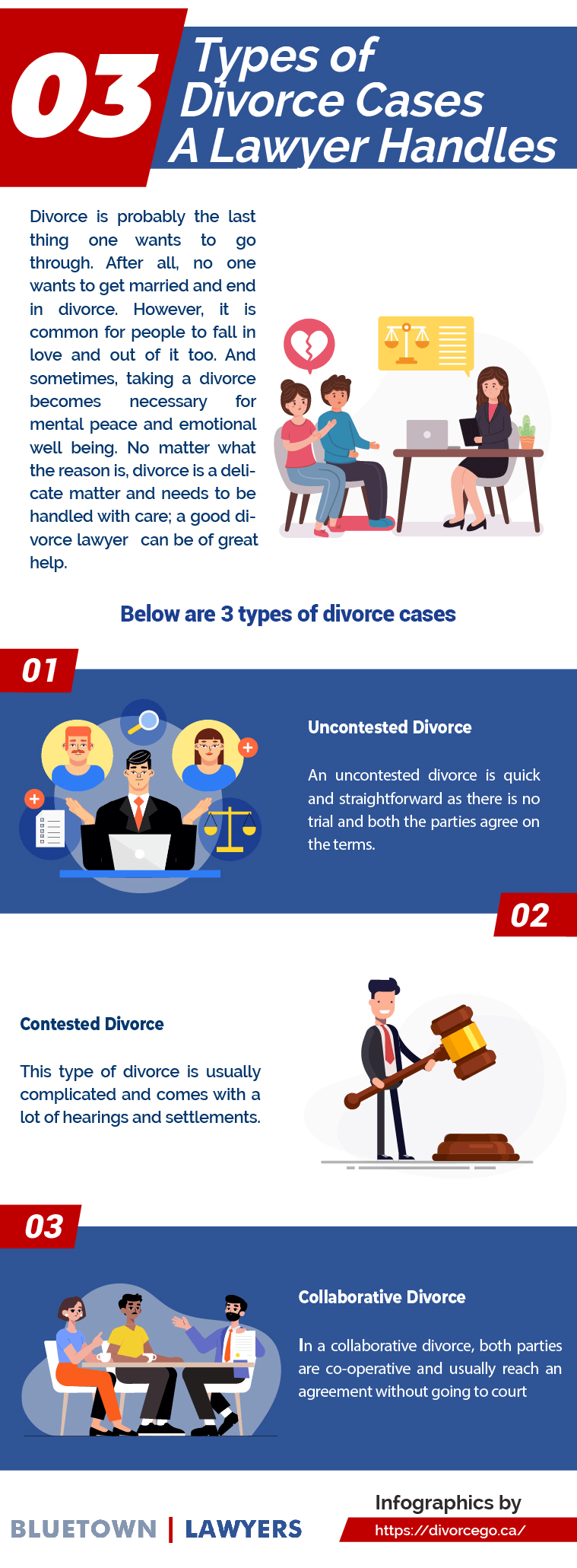
Infographic: 3 Types of Divorce Cases A Lawyer Handles
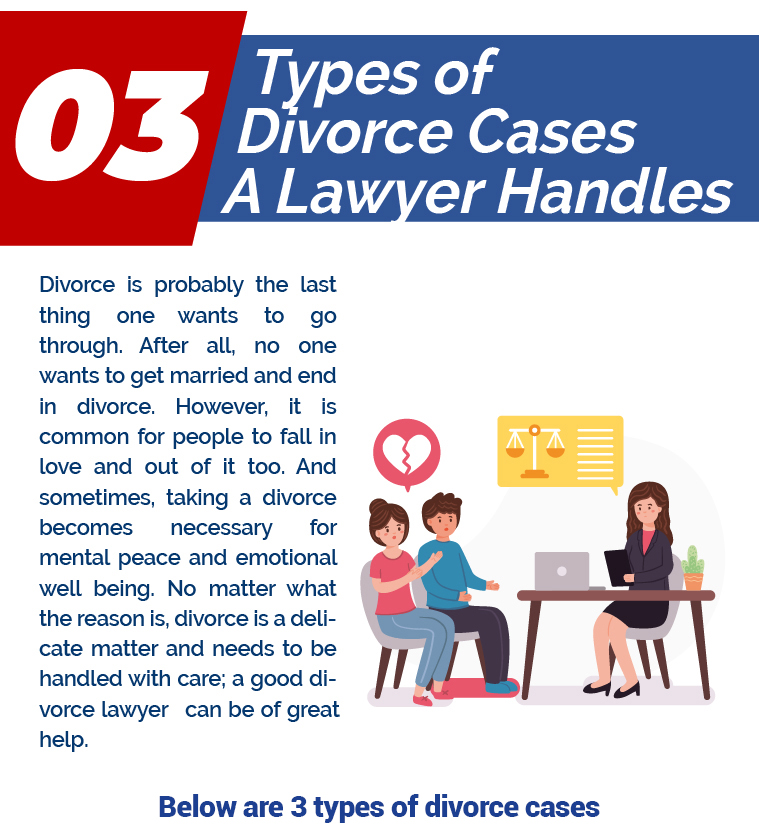
There are many reasons for divorce, including marrying young, limited education and income, living together before a commitment to marriage, cheating on partner and feelings of insecurity. A contested divorce, this well-known type involves both the partners hire separate lawyers and take disputable issues in front of the court for the judge to come up to an ideal decision. The formal process involves settlement negotiations, hearings etc.
A collaborative divorce is another form of resolving contention between a divorcing spouse without bringing the court into the frame. This type of divorce involves both spouses retaining their own legal counsel, an attorney with a special focus on collaborative law. On the other hand, an uncontested divorce relies on both spouses working together to hammer out the terms and try to resolve the dispute. Such a process involves both file separate paper work with the court before going their separate ways peacefully.
Share this Infographic On Your Site
Five Survival Strategies You Need To Cope Up With Life After Divorce

During separation or divorce, everyone is filled with doubts, wondering whether it’s the right decision. Much more is how life will be after. No matter how well one is prepared, coping with separation and divorce can be very difficult. The prime months after divorce may even make you unproductive in your work. The fact is that healing takes time. Thus if you divorce in Ontario, you need to have some survival strategies to ensure you don’t get overwhelmed. When you choose to divorce, you should also be aware of the journey of ranging doubts or emotions. Nonetheless, learning how to cope with the situation may place you in a better position.
How Do I Thrive After Separation Or Divorce?
If you have just gone through a separation or divorce, I know you that your vibes about life may have feelings of low energy. Five strategies may help you shift your energy and enjoy your life after separation or divorce. They include:
- Have an experienced divorce lawyer: A good Toronto divorce lawyer will offer a shoulder to lean on. The lawyer who may have guided you through your divorce process may be well-equipped to help you. However, you must be willing to share your deepest feelings to get help. Though your lawyer may not have all the time to be with you, he/she can surely offer some great insights as they have dealt with such cases before.
- Get a good support network: There is no single strategy that may ease the pain that divorce brings. However, having a good support network may help you go a long way in getting to adapt to the new life. Life may be hard, especially for non-custodial parents who don’t have all the time to spend with the kids. They may spend a lot of time wondering how the kids will grow, whether there will be any attachment in the future, among other issues. You may get support from friends, colleagues, or your family.
- Maintain yourself: One of the worst things that people do after a divorce is to forget that their self needs love. After divorce, ensure to be good to yourself, take time to go on holidays, meet friends, have healthy diet and relax. Additionally, it would also help if you get enough sleep and exercise regularly. This way, you eliminate stress.
- Keep yourself busy: An empty mind is devil’s workshop. Don’t stay idle; instead, look for what makes you happy. Knowing your purpose will greatly help you develop a clear and easy way to handle life after divorce. If you keep your life lined up with your purpose and what you are, it will help you focus on how to deal with life.
- Let it go: You cannot thrive after divorce if you keep on holding to regrets or pain on whatever happened. If you keep thinking about, “what if, or if only,” you will truly have the hardest hit in your life. Consequently, this will deter you from moving onward. Every time thoughts come in your minds, ask yourself whether they will change anything. This doesn’t mean that you don’t have to acknowledge what you’re feeling.
Getting Help
If you’re thinking about separation or divorce and wonder how you will thrive afterwards, you only need to have an experienced lawyer on your side. The lawyer will help you go over the divorce smoothly, which will have a positive effect as you begin your life without your partner. However, if you have separated or divorced with your spouse and you’re unable to cope with life, you may get a professional marriage counselor.