
Category: Separation Agreement
Steps For Creating A Workable Parenting Agreement

To avoid future battles after a divorce, both parents should come up with a workable parenting agreement. Though a feasible parenting plan will not remove any possible conflicts, it can help identify any likely issues and hence provide a path to handling such matters in harmony. The presence of a third party in such matters creates all the difference. Anyone going through a divorce in Toronto should keep in mind that even if they seem to agree on all terms of their agreement, it’s advisable to have a lawyer guide them to do the right thing and review their schedule before signing.
The Steps You Should Take To Have A Workable Agreement
Having a routine your kids can work on may help them handle the split with ease. However, coming up with this routine is the key to your kid’s happiness, even when things seem to be tough. There is a way you can ensure to establish a good parenting agreement. Below are some few steps you may put into consideration:
- Open up lines of communication with the other parent: This is the first step to ensure that you will indeed talk about the best interest of your children. In such away, you can come up with a plan to ensure your kids have the support they need from both of you. Besides, you can plan on a mode by which you will keep in touch. It helps when kids start moving between homes as you need to share updates. It’s unwise to wait until you have divorced to have such decisions.
- Hire a family lawyer to help you draft the agreement: Having a lawyer is necessary to facilitate communication. It would help if you were willing to let your lawyer have all the documents related to calculating things like child support. This could include your income; tax returns pay stubs etc. You will get advice on what to include, such as money issues, living arrangements, among others. However, even before you get such advice, you should be prepared with your ideal parenting schedule. This is also important since a parenting schedule has a legal implication. Having a lawyer to guide you can make it official.
- Follow the court orders: Just like any other enforceable court order, you need to ensure you don’t violate any provision made by the judge as this could subject you to fines or penalties.
- Keep up with your goals: Once you come up with a parenting schedule, it’s your part to maintain the goals you have set towards your children. Don’t wait for the other parent to fulfill their role. Strive to have the best for your children to help shape their future.
What If There Is Disputes In A Parenting Plan?
While some parents work together to reach a joint agreement, others bring up chaos and remain in conflict with the other parent. In such cases, a parent can only choose to have a legal representative who may attempt to resolve the dispute without going to court. Also, you can write up your parental agreement and have a lawyer assist you. A workable parenting agreement is a better tool to allocate both parents’ responsibilities.
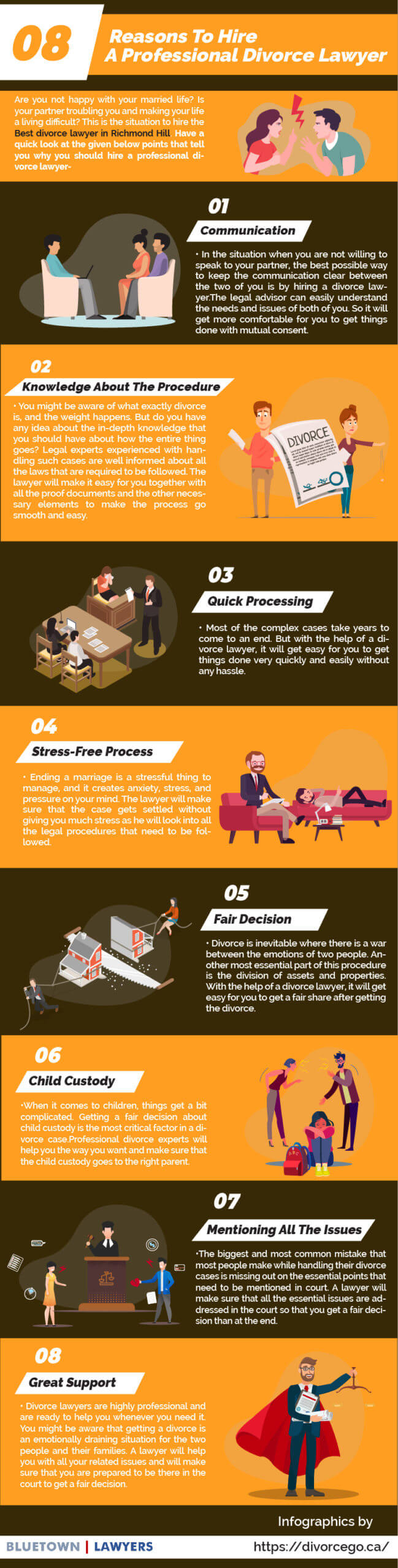
Infographic: 8 Reasons to Hire A Professional Divorce Lawyer

Is your partner making your life miserable? If you want to divorce him, then to separate lawfully, you will need the help of a family lawyer. If you are not willing to talk to your partner, then you can rely on an experienced divorce lawyer to ensure clear communication between both of you. He can understand the issues both of you have and can get things done with mutual consent.
Lawyers who have handled divorce cases in the past have a good idea of the laws that need to be followed for legal separation. The legal expert will collect all documents on your behalf to ensure that the proceedings of the case move smoothly. Complex divorce cases take years to end. But a good divorce lawyer will get things done for you quickly. Divorce causes a lot of anxiety and stress. The lawyer will ensure that the case is settled without you going through any mental anguish.
Share this Infographic On Your Site
What If My Spouse Refuses To Sign Our Separation Agreement?

The essence of a separation agreement is to make sure disputes that may arise when spouses are separating are settled. The agreement helps to outline the roles and responsibilities of each spouse which are legally binding. While it’s not a mandatory requirement to have a separation agreement in Ontario, if a couple wants to end their relationship, it’s highly recommended to help clarify issues that may drag up the separation. Sometimes, one spouse may challenge the agreement for a variety of reasons and may end up refusing to sign the separation agreement. The fact is, you can’t force your spouse to sign, but you may have many options to ensure the process still moves on. If your partner happens to be against your separation agreement Ontario, your only option would be to commence legal proceedings. Continue reading “What If My Spouse Refuses To Sign Our Separation Agreement?”
Can Being Divorced In Canada Affect My Immigration Status?

Even though marriage is considered the foundation for the life of many Canadians, the decision to divorce is also respected. However, for one to divorce, certain conditions must be met. For most individuals, this doesn’t seem easy. But what happens for that individual who’s thinking about divorce and wondering how it might affect his/her immigration status. The contentious issue is when you are getting a visa through your spouse and in between the process your spouse decides to divorce before you become a permanent resident, how should you handle the divorce? Undoubtedly, this could be an uphill battle in your mind, but the divorce lawyer can do everything possible to ensure you go over the issue with ease. Continue reading “Can Being Divorced In Canada Affect My Immigration Status?”
What Do I Need To Have A Successful Separation Agreement?

If you are married in Ontario, or you are in a common-law relationship, you can make a separation agreement. This is when both of you have agreed on what you want to happen after you separate. A separation agreement Ontario won’t make you get divorced, but it can be used to help you have a smooth divorce. To have a successful separation agreement, both of you need to agree on all things. Not agreeing on everything may not be a good sign when preparing a separation agreement. However, you can talk to your partner with the help of a lawyer or a mediator. You need to learn a few things to make the process easier.
Three Factors To Consider To Have A Successful Agreement
A separation agreement is a legal separation where spouses ask the court to allow them to separate and hence end any marital obligation to each other. The only difference here is that the spouses are still technically married though they have not intended to end their marital status. Though drafting a separation agreement may spend less time, it advisable to have legal advice before signing one. The help of a Divorce lawyer Toronto can help you understand your rights more clearly and understand the responsibilities both of you have for your children. You may consider the below vital factors when deciding to draft a separation agreement:
- Make an informed consent: This is one of the most challenging parts when you think about separation. The issue being will you have an amicable process, or will your spouse spring up war? If you are certain you want to separate, make sure to announce your decision in a calm manner. Your desires should be firm and direct. Make sure not to have too many details during your initial discussion.
- Disclose your financial position: It only with a full and accurate financial disclosure that your partner won’t react negatively. Except for all other issues, financial disclosure is the main issue of contention in a separation process. Spouses should make sure they have an accurate financial position of each other. In addition to this, the financial records relating to the parties, either for incomes or debt, should also be made clear by both spouses. That’s the reason why a separation lawyer is needed to advise on what needs to be disclosed.
- Getting financial advice singly: Even if you’re drafting a separation agreement in unison, you should obtain legal advice from a different lawyer other than the one offering service to your spouse. This is important in case your spouse may decide that your separation agreement been done away with. You will have a Certificate of Independent Legal Advice (ILA) to show. Your agreement will be deemed to be binding if both of you have a lawyer.
Your Next Step
If you are considering divorce but have not yet decided to split up, a separation agreement is perfect for you. Take time to get legal advice when you are writing up a separation agreement. If you have informed consent and have fully disclosed your financial status, then you’re ready to make your separation agreement.
Mistakes To Avoid When Considering A Separation Agreement In Ontario

No one wishes to spend money on divorce, particularly when it’s in short supply. That’s why many couples find it easier to separate rather than divorce. Others separate in preparation for their divorce. If you have decided to separate from your spouse, the best thing is to have a separation agreement in Ontario with the help of a family lawyer. However, if you’re not careful about your separation agreement, this could lead to the biggest mistake that could affect the ruling of your divorce.
Tips On What To Avoid When Preparing For A Separation Agreement
It would be better to avoid the below mistakes in the process of drafting your separation agreement and also that in case of divorce, things run smoothly:
- Airing your separation: Most people use social media to air their grievances. This information may be used against you. Further, people may define your needs, which may not be accurate for your situation. If you let out any information, your spouse will most likely hear about it, and he/she may not take it positively.
- Signing any document without your lawyer: It’s vital to understand your rights when separating. Your spouse may have documents that he/she may want you to sign. Never accept to sign them without the advice from your lawyer.
- Becoming violent to your spouse: If you commit any violent act to your spouse, either physical or emotional, it can lead to domestic violence. This may have other legal consequences, such as being forced to hire a criminal lawyer, which may affect your divorce in terms of time taken to resolve other upcoming cases.
- Moving out from home: If you move out from home before the separation, it may affect your chances of retaining precious time with your kids. You can’t live away from your kids and fail to interfere with the parent-child relationship. You should not leave unless there is a risk of harm.
- Making financial commitments: If you make financial commitments before the final agreement, you could lower your chances of getting what belongs to you legally. You should act reasonably when it comes to issues related to finances.
- Failure to take care of your physical and emotional health: Separation is not easy as it takes a toll in various ways. One of them is becoming emotionally stressed. You need to maintain yourself for life after separation or divorce. You can do this by joining support groups or exercising regularly.
- Involving your kids in your disputes: Most spouses unintentionally have heated arguments when their kids are watching. You should be conscious of the kid’s presence since this can affect them negatively.
- Being dishonest: This may happen, especially when one spouse wants to hide marital assets. This could result in losing vital grounds for divorce.
Speak To An Experienced Divorce Lawyer
During the process of preparing a separation agreement, it’s vital to seek legal help from a top divorce lawyer in Toronto. He/she can ensure you avoid the above mistakes that could cost you when it comes to divorce. A good lawyer has an understanding of how your rights can be protected and can take you through each step of your divorce process.
Divorce Process Overview Pt. 1

If you have decided on a separation and a divorce it is necessary to become aware of the divorce process where you are. This article and a following one will discuss an overview of the divorce process in Ontario.
Firstly, it is important to realise that in Ontario there really is no such thing as being legally separated. The reality is if you are not divorced then you are still married until you are formally divorced. Such a divorce takes place one year from the date of separation, at which point you are allowed to apply for a divorce decree. A common question to ask is: what then is done in the meantime during the one year, waiting to make the application for a divorce decree? It is during this time that you and your spouse work to create a separation agreement that legally dictates how you will deal with your children, your home, all of your assets, your pensions, debts and any support issues. To put it into perspective, the most important document in the whole divorce process is your separation agreement and not the divorce decree.
Therefore, it is correct to say that you divorce process is about creating a separation agreement that allows you and your family to make decisions, protect your interests and to move on with your life. The separation agreement in itself is likely the most important document that you will ever sign during the divorce process. Since the separation agreement is such a big deal, the task of drafting it should not be taken lightly. Drafting a separation agreement usually involves a combination of financial disclosure, whereby parties reveal all their finances to one another, creating and signing a separation agreement deals with all issues pertaining to life after separation and after divorce.
It is important to note that spouses have the important job of coming up with the separation agreement, however, they may decide to put faith in the family court system. It is important to note that the court system in itself is expensive and therefore, it is wise for spouses to draft their own separation agreement based on their circumstances and the situation at hand and tailor make the agreement to their family’s needs and situation.
There are a number of elements that play a pivotal role with regards to the separation agreement, some of these include the following:
Determining the date of separation – to formally start the divorce process it is when one spouse tells the other that it is their intention to separate. The date that a spouse has this discussion will usually become what is referred to as the date of separation. This date is of extreme importance as that is the date used for valuations, dividing up assets, financial disclosures, any support payments to be made and the divorce application once the separation agreement has been complete. As noted previously, it is one year from the separation date that the divorce decree application can be made.
Separation, Divorce and Taxes
Once spouses decided to separate and divorce, generally the last thing anyone thinks about is the tax implications of such actions. This article will discuss basic tax implications with regards to separation and divorce and legal requirements with regards to tax and separation.
It is important to note that when you and your spouse divide up your real estate, savings, investments, and pensions this is referred to as the division of assets. By paying your spouse their half of the assets this is referred to as equalization payments as well as an asset transfer. Where any of these payments are made in cash there are no tax implications during the divorce as it is considered to be money that you have already been taxed on. However, when assets are transferred, such as a car or investment normally these are taxed. These would normally be taxed at the difference between the current market value and what you initially paid for them. When it comes to the transfer of asset it is of the utmost importance to involve a financial professional who works specifically with divorce in order to provide options for temporary tax exemptions. Such professionals are referred to a certified divorce financial analyst.
With regards to child support payments it must be noted that there are no tax implications. This is mainly because child support payments are not considered an income for the person who is receiving it, as such there is no tax deductible on the person who pays and receives the child support payments. However, with regards to spousal support there are tax implications for both the person making the payments and the person receiving it. It must be noted that there are available options that reduce the taxation on spousal support these include:
Periodic spousal support payments – periodic support payments are monthly payments. Periodic payments are taxed as extra income for the recipient and are deduction from the one who makes payment.
Lump sum payment – lump sum payments are not taxable or deductible if the support payments are made according to a properly prepared separation agreement.
In accordance with the Divorce Act an individual is considered to be separated if he or she lives independently from their spouse while staying in the same home. However, when it comes to the Canada Revenue Agency (CRA) it must be noted that a spouse is considered separated when he or she lives separate and apart from their spouse for a period of 90 days or more as a result of a breakdown in their relationship. Any separation that is less than 90 days is not considered a separation for the purposes of Child and Family Benefits with regards to divorce and taxes. With regards to the issue of living separately while it is possible for spouses to be considered legally separated while living in the same home, according to the CRA the spouses are not considered separated. This is because the CRA has different standards when it comes to divorce and taxes as compared to the legal system.
Frequently Asked Questions on Separation Agreements

Frequently Asked Questions
There are a number of questions that people ask in respect of separation agreements. This article will address some of the frequently asked questions in relation to separation agreements Ontario.
1. What is a separation agreement?
A separation agreement is a contract between two parties to a divorce or separation. The fact that it is a contact means that its contents are legally binding to the parties of the agreement and is governed by the law of contracts. Therefore, if any parties to the agreement fail to execute the terms of the contract either party may bring a claim for breach of contract. However, if the separation agreement is unfair or unreasonable a court will set aside such a contract and will not enforce it. For example, a separation agreement that is unreasonable is one that may exempt the noncustodial parent from paying child support to the custodial parent.
2. What aspects may be addressed in a separation agreement?
A number of aspects pertaining to how the two spouses want to handle their affairs once separated and or divorced, some of these aspects can include but are not limited to the following:
- Custody and access to a child or children
- Spousal support
- Child support
- Child maintenance
- Debts
- Property division
3. When will a court refuse to recognize a separation agreement?
Generally courts refuse to recognize and enforce a separation agreement as binding to its parties in the following situations:
- Where the terms of agreement are not in the best interests of the child
- A spouse has not fully disclosed certain assets or liabilities
- The separation agreement is unfair, for example, one spouse waives his or her right to support without compensation
4. How do we determine spousal support?
When addressing spousal support there is need to consider the following factors (this list is not exhausted):
- Length of marriage – normally the longer one is married the longer one spouse becomes financially dependent on the other
- Former standard of living – generally courts like to see financially dependent spouses live according to the standard of living that he or she was used to during the marriage
- The age and health of the spouse receiving spousal support – younger spouses who are in good health are generally viewed to require shorter periods of receiving spousal support as they are still able to find work and find a means of providing for themselves. Conversely, if the spouse is older and has poor health he or she may require more support as he or she is not likely to be able to provide for his or herself.
- Future financial prospects of the paying spouse – spouses who are likely to be earning more in the future are often expected to pay more spousal maintenance than those who have reached the peak of their careers and have low to no chances of earning more in future.
A caution is given to persons in violent relationships or relationships where there is an imbalance of power to not have a separation agreement.
Looking for a trusted Toronto Divorce Lawyer? You can have a FREE consultation with us at DivorceGo.
Separation Agreement Lawyer Ontario

Ontario Separation Agreement Lawyer
What is a Separation Agreement in Ontario?
If you are contemplating a separation or are separated from your spouse or common-law partner, a domestic contract known as a ‘separation agreement’ may be drafted to make arrangements for issues such as:
- Division of Property (i.e. who gets to keep the car);
- Spousal support/spousal support releases and child support;
- The living arrangement of the children (i.e. custody and access).
- Parenting plans (i.e. religious issues, educational matters, travel etc.)
- Debts, pensions, medical/dental benefits, life insurance.
It is inadvisable to simply have a verbal agreement between two separating partners as it may be highly difficult to prove verbal agreements before a court of law.
A separation agreement is not a requirement to getting separated or obtaining a divorce. It primarily serves to provide definition and clarity in what can be a highly confusing and stressful situation. You do not need a lawyer to draft a separation agreement as long as it is signed by both parties in front of a witness and dated.
However, while you do not formally need a lawyer to draft a separation agreement in Toronto, it is highly recommended to retain a lawyer to draft a separation agreement as determining spousal rights and responsibilities upon the break down of a relationship maybe a highly complex task. Your lawyer will navigate you through the process to ensure you fully understand your rights and obligations under the separation agreement and that the separation agreement is clear, complete and legally enforceable.
If you cannot agree on the contents of the separation agreement, you may also choose to go to a mediator who will then mediate the issues you and your spouse or partner are facing and then try to come to solution that is agreeable to both.
Independent Legal Advice and Separation Agreements
One lawyer cannot act for both parties who are in need of advice in respect of advising on the contents of a separation agreement in Toronto. The parties must obtain their own independent legal advice. The reason for this is that a lawyer cannot fairly represent parties whose interests are not aligned. As is often the case in family law litigation, there are significant difference of opinions when determining rights and responsibilities of the parties involved. Therefore, independent legal advice becomes vital before signing a separation agreement.
It is also advisable to obtain and execute an Independent Legal Advice certificates so that in the future, a party will be unable to claim that they did not understand the content of the separation agreement making it unlikely for the court to set aside the separation agreement in Toronto on that basis.
What Is Considered A Legally Enforceable Separation Agreement In Toronto?
Section 56(4) of the Family Law Act provides that a separation agreement will be found legally enforceable if all three criteria were present at the time the agreement was executed:
- significant assets and significant liabilities of both parties were disclosed at the time the agreement was made;
- both parties understood the nature or consequence of agreement made;
- the agreement was made in accordance to the law of contract. (i.e. the agreement will not be legally enforceable if it contains terms that are illegal)
Can A Separation Agreement Be Set Aside?
The Family Law Act grants the court the power to set aside or nullify a Separation Agreement or any clause in that contract if:
- a spouse failed to disclose to the other significant assets, significant debts or other liabilities that existed when the Separation Agreement was made;
- if a spouse signs an agreement while being forced, coerced, or under duress
- if a spouse did not understand the nature or consequences of the Separation Agreement; or
- if the Separation Agreement was not prepared in accordance with the law of contract.
Contact our Ontario Separation Agreement Lawyer
Before you sign a separation agreement you must understand that the decisions made in this agreement will effect your future and your children’s future. A legally valid separation agreement must be abided by and will likely be upheld in a court of law in case of dispute. Therefore it is utmost important and best to have it created by and reviewed by a divorce lawyer Toronto to ensure the protection of your rights.