
Parenting Plan in Ontario: Guide for Separated Parents
Key Takeaways
- A parenting plan is a written agreement that outlines how parents will care for their child after separation.
- It can cover parenting time, decision-making responsibility, holidays, school breaks, and communication rules.
- A strong parenting plan reduces conflict, creates stability, and protects the child’s routine.
- Parenting plans can be included in a separation agreement and may support future court orders if needed.
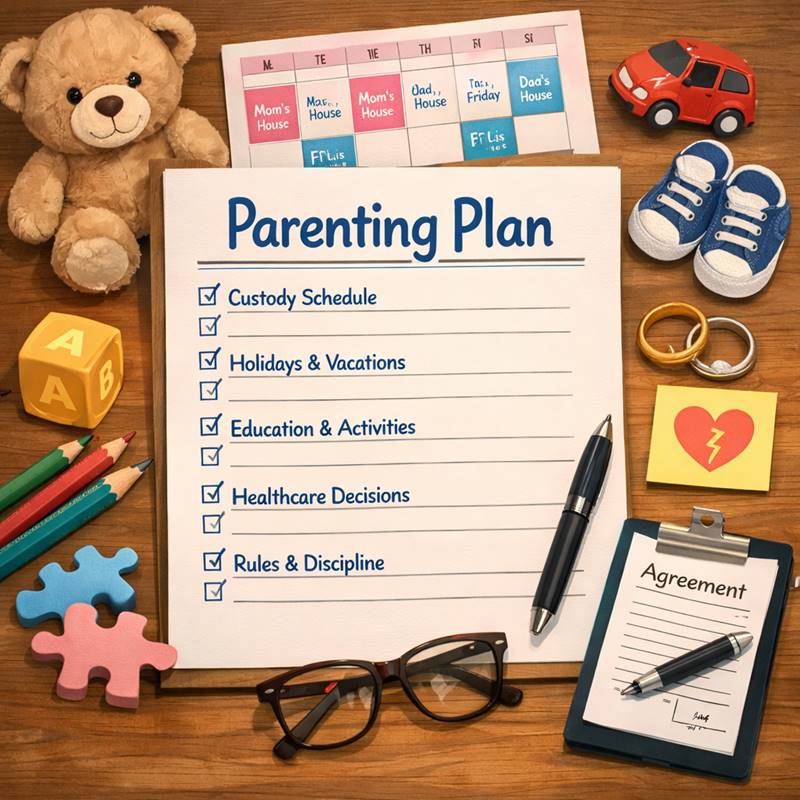
What Is a Parenting Plan in Ontario?
A parenting plan in Ontario is a written plan that explains how separated parents will raise their child going forward. It sets out the day-to-day and long-term rules that help parents share responsibility while keeping the child’s life stable and predictable.
In simple terms, it answers questions like:
- Where will the child live during the week?
- How will weekends be handled?
- Who makes important decisions about school or medical care?
- What happens on holidays, birthdays, and school breaks?
- How will parents communicate and share updates?
The goal is not to “win” or control the other parent. The goal is to create a plan that works in real life and supports the child’s routine.
A Parenting Plan Is Not Only for “High-Conflict” Situations
Some parents think they only need a parenting plan if they are fighting or going to court. That is not true.
A parenting plan is helpful even for parents who are on good terms, because life changes over time. Work schedules change. Children grow. School needs change. Holidays arrive. New relationships happen.
A written plan helps parents stay organised and avoid future arguments.
In many cases, the best time to create a parenting plan is before conflict grows, not after.
A Parenting Plan Can Support a Court Order If Needed
Many parents want to avoid court, and that makes sense. Court can be expensive, stressful, and slow.
However, even if you do not plan to go to court, having a clear parenting plan can still help protect you and your child’s routine if there is ever a dispute in the future.
A well-written parenting plan may support court applications later by showing:
- what the parents previously agreed to
- what routine the child is used to
- what has worked successfully in the past
- what the parents intended for decision-making and parenting time
What to Include in a Parenting Plan
A) Parenting Schedule (Parenting Time)
Your parenting schedule (also called parenting time) is the foundation of the parenting plan. It sets out when the child is with each parent and how transitions will work. The more specific you are, the fewer arguments happen later.
Weekday routine
This section should clearly state what a normal school week looks like. For example:
- which parent the child stays with on Monday to Friday
- who handles school mornings (wake-up, breakfast, drop-off)
- who picks the child up after school
- how homework routines will be supported
If your child is not in school yet, you can still outline weekday routines based on daycare, naps, and regular daily structure.
Weekends
Weekends often cause confusion if they are not written clearly. Make sure you include:
- which weekends each parent has
- whether weekends alternate (every other weekend) or follow a set pattern
- what time weekend parenting time begins and ends
If the child has activities on weekends (sports, lessons, family events), note how those will be handled.
Drop-off and pick-up times
Time issues are one of the most common sources of conflict. Your plan should list exact pickup and drop-off times, such as:
- “Pickup is Fridays at 5:00 p.m.”
- “Drop-off is Sundays at 6:00 p.m.”
Try to avoid vague terms like “evening” or “after work.” Clear times create clear expectations.
Exchange locations (school, home, neutral place)
Transitions are easier when everyone agrees on where exchanges happen. Common exchange locations include:
- the child’s school or daycare (often the easiest option)
- one parent’s home
- a neutral public location (sometimes preferred if conflict is high)
Many parents use school exchanges because they reduce face-to-face contact and keep transitions smooth for the child.
Handling late arrivals or missed time
This section helps prevent repeated frustration and blame.
Your parenting plan can clarify:
- what counts as “late” (example: more than 15 minutes)
- whether the late parent must notify the other parent
- what happens if a parent does not show up
- whether missed time can be made up later, and how
It’s also helpful to include a calm rule like:
“If a parent will be more than 15 minutes late, they must notify the other parent as soon as possible.”
The goal is not punishment. The goal is protecting the child from stress and uncertainty.
B) Decision-Making Responsibility
Decision-making responsibility is about who has the legal authority to make important choices in the child’s life. This is separate from parenting time.
In a parenting plan, decision-making should be clearly explained so parents don’t argue about “who decides” later.
Who makes major decisions about:
Most plans cover the main decision categories, including:
Education
This includes things like:
- school selection
- special education supports
- tutoring decisions
- major school changes (switching schools or moving districts)
Health care
This includes:
- doctor appointments and treatment decisions
- mental health care
- dental and orthodontic treatment
- medication plans (especially long-term medication)
Religion and culture
This may include:
- religious practices and celebrations
- cultural traditions and events
- agreements about introducing the child to certain beliefs
Extracurricular activities
This includes:
- signing the child up for new activities
- cost sharing (if addressed elsewhere in the plan)
- time commitments that affect the parenting schedule
A good plan explains not only who decides, but also how parents communicate when decisions are needed.
Joint decision-making vs one parent having final say
Some parents agree to joint decision-making, meaning both parents must discuss and agree on major choices.
This works best when:
- communication is respectful
- both parents are reliable
- conflict is manageable
Other parents agree that one parent has final decision-making authority in certain areas (or overall), especially when:
- parents cannot cooperate
- conflict is ongoing
- important decisions are being delayed
Even when one parent has final say, it is still common to require discussion and notice before decisions are made. The goal is still to keep both parents involved in the child’s life.
When a parent must notify the other parent
Your parenting plan should clearly say when notice is required, such as:
- medical appointments (routine or urgent)
- school issues (behaviour, academic concerns, suspensions)
- travel plans
- changes in address, phone number, or emergency contact info
It can also include rules like:
- sharing report cards, school emails, and medical updates
- providing copies of important documents upon request
This keeps both parents informed without constant arguments.
C) Communication Rules Between Parents
Communication can either keep co-parenting stable, or it can turn into daily conflict. That’s why it helps to include communication rules in your parenting plan.
This section is not about controlling each other. It’s about creating boundaries so communication stays child-focused and respectful.
Preferred method: text/email/co-parenting app
Parents can choose what works best, such as:
- email (best for detailed updates)
- text message (best for quick logistics)
- a co-parenting app (helpful for shared calendars and records)
Many parents prefer email or apps because it reduces emotional back-and-forth and keeps conversations organised.
Expected response time
Misunderstandings happen when one parent expects an instant reply and the other parent is busy.
Your plan can include a reasonable standard, such as:
- “Parents will respond within 24 hours for non-urgent matters.”
- “Same-day response is expected for schedule issues involving the next 48 hours.”
This reduces pressure and prevents unnecessary conflict.
Respectful language boundaries
To keep communication productive, include rules like:
- no insults, sarcasm, or threats
- no discussing past relationship issues
- messages must focus on the child and parenting logistics
- no repeated messages or harassment
This protects both parents and helps reduce stress for the child too.
Emergency communication rules
Emergency rules should be clear and simple.
For example:
- emergencies should be handled by phone call, not email
- a parent must notify the other parent as soon as reasonably possible
- if the child is sick, injured, or taken to urgent care, the other parent must be informed right away
This ensures the child’s safety comes first.
D) Child Communication With the Other Parent
Even when the child is staying with one parent, the other parent should usually have reasonable contact. This helps maintain bonding and emotional security, especially for younger children.
A parenting plan can set fair, realistic expectations so calls don’t become stressful or disruptive.
Calls and video calls rules
Include practical details such as:
- which days calls will happen
- what time calls are best (before bedtime, after homework, etc.)
- whether video calls are allowed or preferred
Try to keep the schedule consistent, but not overly strict. The goal is connection, not control.
Reasonable access without interrupting routines
Your plan should protect the child’s normal routine, including:
- school time
- meals
- homework
- bedtime
A child should not feel pulled in different directions or pressured during the other parent’s time.
A fair approach might be:
- “Reasonable communication is allowed as long as it does not interfere with the child’s routine.”
What happens when the child doesn’t want to talk
This is common, especially when the child is tired, emotional, distracted, or adjusting to separation.
Your parenting plan can address this in a calm way, such as:
- the child will not be forced to speak
- the parent who has the child will encourage connection in a supportive way
- the other parent can try again later
- no parent will blame the other if the child refuses
FAQs
Is a parenting plan legally binding in Ontario?
A parenting plan can be legally binding, depending on how it is created and used. A parenting plan is more likely to be legally binding when it is:
- included as part of a separation agreement, or
- made into a court order, or
- referenced in a consent order after parents agree on the terms
In general, the more formal and properly documented the parenting plan is, the easier it is to rely on later if problems arise.
What should be included in a parenting plan in Ontario?
A strong parenting plan in Ontario should be detailed enough to prevent confusion and conflict.
Most parenting plans include:
- parenting schedule (parenting time) including weekdays, weekends, and exchange times
- decision-making responsibility for major issues like education and health care
- holiday and vacation schedules, including summer and school breaks
- communication rules between parents (email, text, co-parenting app, response times)
- child communication rules (calls/video calls with the other parent)
- how disputes will be handled, such as mediation before court when possible
The best parenting plans focus on what works in real life and keep the child’s routine stable.
Can a parenting plan be changed later?
Yes. A parenting plan can be changed later if life circumstances change.
What if the other parent refuses to follow the parenting plan?
A practical approach often includes:
- documenting what happened (missed exchanges, late pickups, refusal to follow rules)
- saving texts/emails related to the issue
- avoiding arguments in front of the child
- trying to resolve the problem through respectful written communication
If the issue continues, many parents consider:
- mediation to fix the problem before it escalates
- legal advice to understand next steps
- seeking a court-based solution if the plan is part of an agreement or court order and the situation is serious
The key is to take the problem seriously, but avoid reacting in a way that creates more conflict for the child.
Can we create a parenting plan without going to court?
Yes. In fact, most parents create a parenting plan without going to court.