
One-Year Separation Rule in Ontario
Key Takeaways
- In Ontario, most divorces are based on living separate and apart for at least one year.
- You can be separated even if you still live in the same home, depending on how you live day-to-day.
- The separation date matters because it affects divorce timing and may impact property and support issues.
- You can start divorce paperwork before the one-year mark, but the divorce usually won’t be finalized until the year is complete.
What Is the One-Year Separation Rule in Ontario?
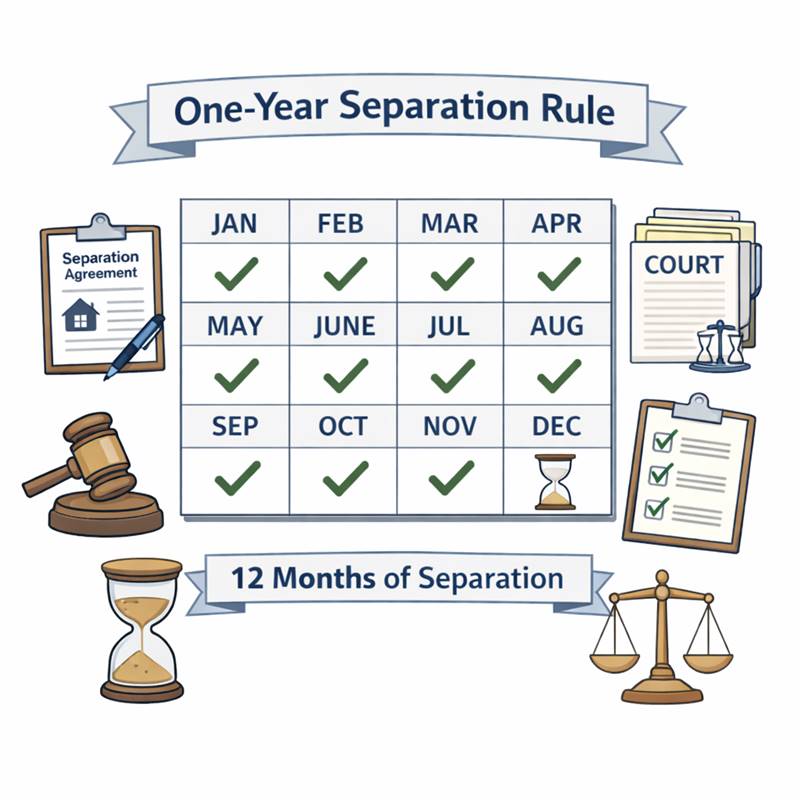
In Ontario, the one-year separation rule means that a court can grant a divorce only after spouses have been separated for at least 12 months (one full year). In simple terms, the one-year separation rule is a timeline requirement. It does not mean you need to “wait” to start preparing. It means the court generally cannot finalize the divorce until the year has passed.
What does “separate and apart” mean in plain terms?
The legal phrase “separate and apart” does not only mean living in different houses. It means you are no longer living together as a couple.
You are generally considered separated when you stop living like spouses, meaning the relationship has ended in a real and practical way. That typically includes things like:
- No longer sharing a romantic relationship
- No longer acting like a couple socially
- No longer living as one household unit
- Having separate daily routines, responsibilities, and boundaries
A separation can begin even if you are still under the same roof, as long as your lifestyle clearly shows that the marriage has ended.
When Does the One-Year Separation Clock Start?
The separation period starts on the separation date
The separation period begins the moment the relationship changes from being a married couple to being separated spouses.
To be considered separated, you do not need to file a document or go to court right away. Separation can happen informally. The key is that the marriage has broken down in a real way, and your day-to-day life reflects that.
What is the separation date?
Your separation date is usually when one or both spouses decide the marriage is over and begin living accordingly.
It’s not always a single dramatic event. For many couples, it’s a clear turning point. For others, it happens gradually. But legally speaking, the separation date is typically the day when:
- one spouse communicates the relationship is over, and
- both spouses begin acting in a way that supports that decision
You don’t have to be fully “moved on” emotionally. You just have to be living as separated spouses rather than as partners.
Examples of what can trigger the separation date
A separation date can be triggered by different situations, depending on the couple’s reality. Common examples include:
1) Moving out
This is the simplest and most obvious scenario. If one spouse moves out of the matrimonial home and you stop living together as a couple, that date often becomes the separation date.
For example:
- One spouse moves into a new apartment on May 1
- The couple stops living together and begins separate lives
➡️ May 1 may be treated as the separation date
2) Living separately under the same roof
In Ontario, you can still be separated even if you both stay in the same home.
This often happens when:
- finances are tight
- you have children and want stability
- you need time to plan housing
- one spouse refuses to leave
In these cases, a separation date may be the day you start living independently within the home, such as:
- sleeping in separate rooms
- no longer cooking or eating together as a couple
- dividing chores and responsibilities
- keeping separate finances
- no longer attending events together as spouses
- no longer acting as a couple in front of family or friends
Even though you share an address, your relationship and household function differently.
3) Clear communication that the relationship ended
Sometimes, the separation date starts with a direct conversation. One spouse says something like:
- “I’m done. I want to separate.”
- “I don’t want to be married anymore.”
- “We’re not together anymore, even if we’re living here for now.”
If the couple then begins living separately in practice, that conversation can help establish the separation date clearly.
Do You Have to Wait a Full Year to File for Divorce?
In Ontario, you do not always have to wait a full year to file for divorce. But in most cases, you do have to wait a full year of separation before the court can grant the divorce.
Filing for divorce vs. getting a divorce order (what’s the difference?)
Many people think divorce is a single step. In reality, there are two separate stages:
1) Filing for divorce
This means starting the legal process by submitting the divorce application and paperwork to the court.
2) Getting the divorce order (finalizing the divorce)
This means the court reviews the file and officially grants the divorce once legal requirements are met.
So even if you file early, the court generally will not issue the divorce order until the one-year separation period is complete (when separation is the reason for divorce).
Can you start the process early?
Yes. In many Ontario cases, you can start the divorce process before the one-year mark as long as:
- you are already separated and have a clear separation date, and
- you are close enough to the one-year point that the process won’t finish too early
People often do this so they can:
- get paperwork prepared in advance
- avoid unnecessary delays later
- move things along once the one-year separation is reached
Why people file early (and why it can still make sense)
Filing early can be useful because divorce paperwork takes time. You may need to gather:
- marriage certificate details
- accurate dates (marriage date, separation date)
- information about children and parenting arrangements
- support and financial information (if applicable)
Starting early can prevent the situation where a couple waits a full year, then finds out they still need months to complete the court steps.
Common divorce options in Ontario
Ontario offers a few different divorce filing formats depending on whether both spouses agree and whether there are disputes.
Joint divorce
A joint divorce is when both spouses apply together. This is often the simplest option when:
- both people agree the marriage is over
- there is little or no conflict
- the paperwork can be completed cooperatively
Uncontested divorce
An uncontested divorce means one spouse files, and the other spouse does not oppose it.
This option is common when:
- the spouses agree on the divorce
- the responding spouse does not file an answer to dispute it
- the main goal is to finalize the divorce without conflict
Uncontested divorces can still involve important details, especially if there are children or support issues, but the key point is that the divorce itself is not being fought.
Sole application (divorce filed by one spouse)
A sole application is when one spouse files for divorce alone. This may happen when:
- the other spouse is uncooperative
- communication is difficult or unsafe
- the spouses are separated but not working together
A sole application can still be straightforward, but it may require more formal steps, such as properly serving the divorce documents on the other spouse.
FAQs
Do I need to be separated for one year before filing for divorce in Ontario?
Not always. In Ontario, there is a difference between filing for divorce and getting the final divorce order.
Can I be separated and still live together in Ontario?
Yes. In Ontario, you can be separated and still live in the same home, as long as you are living separate and apart in your daily life.
What is considered the official separation date in Ontario?
The separation date is usually the day spouses begin living separate and apart.
Does child support start only after the divorce is final?
No. In Ontario, child support often starts after separation, not after the divorce is finalized.
Can I date while separated in Ontario?
Yes, you can date while separated in Ontario because separation generally means the relationship has ended, even if you are still legally married.