
Category: Divorce In Ontario
Foreign Divorce Opinion Letter vs Foreign Divorce Authorization

What Is the Difference Between a Foreign Divorce Opinion Letter and Foreign Divorce Authorization?
The easiest way to understand the difference is to look at who prepares each document and what it does.
A Foreign Divorce Opinion Letter, also called a Legal Opinion Letter, is prepared by an Ontario lawyer. It gives legal reasons why the divorce or annulment obtained outside Canada should be recognized in Ontario.
Foreign Divorce Authorization is different. It refers to the provincial authorization required in applicable cases before a marriage licence can be issued to someone whose previous marriage was dissolved or annulled outside Canada.
Ontario government materials also describe this as an “authorization to be married after an out-of-country divorce.”
The lawyer provides the legal opinion. The lawyer does not issue the authorization or the marriage licence.
Foreign Divorce Opinion Letter vs Foreign Divorce Authorization
| Issue | Foreign Divorce Opinion Letter | Foreign Divorce Authorization |
|---|---|---|
| What is it? | A lawyer’s legal opinion | Provincial authorization |
| Who prepares or issues it? | An Ontario lawyer | Obtained through the applicable Ontario government process |
| Main purpose | Gives reasons why the foreign divorce or annulment should be recognized in Ontario | Provides the required authorization before a marriage licence can be issued in applicable out-of-country divorce cases |
| Does the lawyer grant the authorization? | No | No lawyer grants it |
| Is it the final marriage licence? | No | No |
| Where does it fit in the process? | Supporting documentation for the authorization request | Comes after the required documents are submitted and reviewed |
| What generally happens next? | The authorization package is completed and submitted | The applicant may proceed with the marriage licence process after receiving the applicable authorization |
How Do a Foreign Divorce Opinion Letter and Foreign Divorce Authorization Work Together?
What Is the Step-by-Step Process in Ontario?
Although individual circumstances can affect the documents or legal analysis required, the usual process can be understood in seven stages.
Step 1: Gather the Foreign Divorce Documents
Start with the foreign divorce documents, including the divorce decree, annulment, or equivalent official record from the jurisdiction where the previous marriage ended.
The document should clearly identify the parties and establish that the previous marriage was legally dissolved or annulled.
For Toronto applicants, the City currently requires an original or court-certified copy of the foreign divorce decree or annulment.
Step 2: Have the Foreign Divorce Reviewed by an Ontario Lawyer
A Toronto Divorce Lawyer reviews the foreign divorce and the facts relevant to whether it should be recognized in Ontario.
Depending on the circumstances, this may involve examining:
- where the divorce was granted;
- where either former spouse was habitually resident;
- when the divorce proceedings began;
- the authority that granted the divorce; and
- other legal grounds that may support recognition.
Section 22 of the federal Divorce Act recognizes certain foreign divorces where either former spouse was habitually resident in the applicable country or subdivision for at least one year immediately before the proceedings began. It also preserves other rules of law concerning recognition of foreign divorces.
Step 3: Obtain the Legal Opinion Letter
Where appropriate, the Ontario lawyer prepares the Legal Opinion Letter.
Ontario requires the letter to be addressed to both people planning to marry and to explain why the foreign divorce or annulment should be recognized in Ontario.
This is an important distinction: the lawyer provides the legal opinion, but the lawyer does not issue the provincial authorization.
Step 4: Prepare the Remaining Authorization Documents
The applicable package generally includes:
- the completed and signed Marriage Licence Application;
- the Statement of Sole Responsibility;
- the Legal Opinion Letter;
- the foreign divorce decree or annulment; and
- the required translation and translator affidavit if the foreign document is not in English or French.
The documents should be reviewed for inconsistent names, dates, missing signatures, incomplete addresses, or other errors before submission.
Step 5: Submit the Foreign Divorce Authorization Request
Ontario’s current instructions require the documents to be sent to the ServiceOntario Marriage Office for validation.
The Office of the Registrar General also provides services relating to authorizations to be married after an out-of-country divorce. Ontario’s terminology confirms that this authorization is a separate government process from obtaining the lawyer’s opinion.
Step 6: Wait for the Authorization Decision
The documents are reviewed through the Ontario process.
The Legal Opinion Letter does not guarantee that authorization will be issued. Additional information or corrected documents may be required depending on the circumstances.
Ontario currently advises that validation of documents relating to a divorce outside Canada may take up to four weeks.
This is a government processing estimate, not a guaranteed completion date.
Step 7: Proceed with the Marriage Licence Process
Once the required Foreign Divorce Authorization has been received, the applicant can continue with the applicable municipal marriage licence process.
In Toronto, applicants divorced outside Canada must obtain the Foreign Divorce Authorization before attending for their marriage licence. The City states that the marriage licence will not be issued if the required authorization has not been obtained.
The sequence is therefore:
Foreign divorce documents → Lawyer review → Legal Opinion Letter → Authorization request → Government review → Foreign Divorce Authorization → Marriage licence process
Each stage serves a different purpose.
How Long Does Foreign Divorce Authorization Take in Ontario?
Ontario currently states that documents relating to a divorce outside Canada must be validated by the government and may take up to four weeks to process.
However, the complete timeline can include more than the government’s review period.
Time may also be needed to:
- obtain the foreign divorce record;
- obtain a court-certified copy where required;
- arrange an acceptable translation;
- collect information needed for the legal review;
- have the Ontario lawyer prepare the opinion letter; and
- correct incomplete or inconsistent documents.
Applicants should therefore avoid treating four weeks as a guaranteed total timeline from first contacting a lawyer to receiving authorization.
People with a planned marriage date may benefit from starting the foreign-divorce and cross-border legal review well in advance.
Can a Foreign Divorce Opinion Letter Be Rejected in Ontario?
Rejected Foreign Divorce Opinion Letter
The word “rejected” can be misleading when discussing a Foreign Divorce Opinion Letter in Ontario. The lawyer prepares a legal opinion based on the facts, documents, and applicable law. The lawyer does not simply submit a form and wait for someone to approve the legal opinion itself.
Several different situations may be described by a client as a “rejection.” For example, the lawyer may determine that there is not enough information to provide a favourable opinion. The documents may need to be corrected or supplemented. There may also be a substantive question about whether the foreign divorce is recognized in Ontario.
Separately, Ontario requires written authorization where a previous marriage was dissolved or annulled outside Canada before a marriage licence can be issued. The Marriage Act also provides for situations where the required authorization is refused.
Understanding which problem has occurred is therefore the first step.
What Does It Mean If a Lawyer Cannot Give a Favourable Opinion?
An Ontario lawyer preparing a foreign divorce legal opinion must be able to explain why the divorce should be recognized in Ontario.
This involves more than confirming that the client possesses a document called a divorce certificate or divorce decree. The lawyer must consider the legal effect of the foreign divorce and whether the available facts support recognition under applicable Canadian law.
For example, questions may arise about:
- where the former spouses lived before the divorce proceedings;
- which country or authority granted the divorce;
- whether the divorce was legally final;
- whether the documents accurately establish the divorce;
- whether the parties had a legally sufficient connection to the foreign jurisdiction; or
- whether another recognition rule applies.
Section 22 of Canada’s Divorce Act provides one important recognition rule. It states that a divorce granted by a competent authority is recognized for determining marital status in Canada where either former spouse was habitually resident in that country or subdivision for at least one year immediately before the divorce proceedings began. The Act also preserves other rules of law governing recognition of foreign divorces.
This means the legal analysis can depend on the particular facts.
If the lawyer cannot establish a sufficient basis for a favourable opinion from the information provided, the appropriate response may be to ask for more evidence or explain the legal concern. It should not be assumed that a favourable letter can simply be issued because the client needs one for an upcoming marriage.
Does an Opinion Letter Guarantee My Foreign Divorce Will Be Recognized?
No. Obtaining a Foreign Divorce Opinion Letter does not by itself guarantee recognition, authorization to marry, or issuance of a marriage licence.
Ontario’s current process requires a person divorced outside Canada to submit several documents, including a Marriage Licence Application, Statement of Sole Responsibility, legal opinion letter, and foreign divorce decree or annulment documentation. The legal opinion must come from an Ontario lawyer and give reasons why the foreign divorce or annulment should be recognized.
The opinion letter is therefore an important part of the process, but it is not the same as the written authorization required under Ontario’s Marriage Act.
The Act states that a marriage licence cannot be issued to a person whose previous marriage was dissolved or annulled outside Canada unless the required written authorization has been obtained.
A lawyer’s role is to provide a professionally supportable legal opinion. The lawyer does not determine on behalf of the Province of Ontario whether the authorization will ultimately be issued.
Can Additional Documents Resolve the Problem?
Sometimes.
If the difficulty is caused by incomplete records, an unclear translation, inconsistent personal information, or missing evidence, additional documents may allow the lawyer to complete the assessment.
For example, a person may be able to obtain a more complete divorce decree, provide identification explaining a difference in names, or arrange an appropriate translation.
However, there is an important difference between a documentary deficiency and a legal recognition problem.
If a document is simply missing, obtaining it may address the concern. If the underlying facts do not provide a clear legal basis for recognizing the foreign divorce, supplying another copy of the same document may not solve the issue.
The lawyer must determine what information is missing and whether additional evidence can meaningfully affect the legal analysis.
Why Can a Foreign Divorce Opinion Letter Run Into Problems?
Can Missing or Incomplete Divorce Documents Cause Problems?
Yes. The lawyer needs sufficient documentation to understand what happened in the foreign proceeding and determine the legal effect of the divorce.
Problems may occur where a client provides only part of a court order or a document that does not clearly establish that the marriage was dissolved. A record may also omit important dates, information about the issuing authority, or other details needed for the legal review.
Ontario currently requires a copy of the foreign divorce decree or annulment as part of the authorization process.
However, the exact documentation a lawyer needs for the legal opinion can depend on the circumstances. A straightforward divorce with clear official records may require less clarification than an unusual proceeding involving several documents or authorities.
An incomplete document does not automatically mean the divorce will not be recognized. It may simply mean that the lawyer needs a better or more complete record before reaching an opinion.
What If My Divorce Documents Are Not in English or French?
Foreign-language documents can create problems if they are not translated in accordance with the applicable requirements.
Ontario states that the divorce decree or annulment documentation submitted for an out-of-country divorce must be in English or French. If the decree is in another language, the applicant must include a translated copy and an affidavit sworn by a certified translator.
The translation must allow the lawyer and the relevant Ontario authorities to understand what the original document establishes.
Important information can include:
- names of the former spouses;
- dates of marriage and divorce;
- court or issuing authority;
- location of the proceedings;
- terms showing that the marriage was dissolved; and
- information indicating when the divorce became final.
A poor or incomplete translation can create uncertainty even when the original foreign document is valid.
Applicants should therefore avoid relying on informal translations when an official translation is required.
What If the Names or Dates Do Not Match?
Differences between documents can require further explanation.
For example, a person’s surname on a foreign divorce decree may differ from the surname shown on a current passport. A name may have been transliterated from another alphabet in several different ways. Marriage and divorce records may also contain different spellings, dates, or locations.
A discrepancy does not automatically invalidate the foreign divorce.
The important question is whether the lawyer can reliably establish the identity of the parties and understand the reason for the inconsistency.
Depending on the circumstances, supporting material may include identification, a marriage certificate, a legal name-change document, or another record linking the different versions of the person’s name.
Dates should also be reviewed carefully. A clerical error can be very different from a conflict that creates uncertainty about when proceedings occurred or when the divorce became effective.
Applicants should point out inconsistencies rather than hoping they will be overlooked. Identifying them early gives the lawyer an opportunity to determine whether further evidence is required.
What If It Is Unclear Whether the Foreign Divorce Was Final?
A document showing that divorce proceedings occurred does not always establish that the marriage was legally terminated on that date.
Foreign legal systems use different terminology and procedures. Some jurisdictions may issue several documents at different stages of the divorce process.
As a result, a lawyer may need to determine whether the document provided represents a final divorce and when that divorce legally took effect.
This distinction matters because the purpose of the opinion is to assess whether the previous marriage was legally dissolved in a way that can be recognized in Ontario.
Where finality is unclear, further court records, certificates, or information about the foreign procedure may be required.
Can Jurisdiction Affect Recognition of a Foreign Divorce?
Yes. Jurisdiction can be central to foreign divorce recognition.
A foreign divorce is not necessarily recognized in Canada merely because another country issued a divorce document. The circumstances connecting one or both spouses to that jurisdiction can matter.
Under section 22(1) of the Divorce Act, a foreign divorce granted by a competent authority is recognized for determining marital status in Canada if either former spouse was habitually resident in the relevant country or subdivision for at least one year immediately before the divorce proceedings began. Section 22 also preserves other legal rules for recognizing foreign divorces.
For this reason, a lawyer may ask where each former spouse lived, how long they lived there, and when the foreign divorce proceedings started.
These questions are not merely administrative. They may help establish the legal basis upon which recognition is being considered.
Cases that do not fit a straightforward statutory recognition rule may require individualized legal analysis rather than assumptions about validity.
What If the Foreign Divorce Procedure Was Different From a Canadian Divorce?
Different does not necessarily mean invalid.
Countries use different courts, government bodies, procedures, terminology, and forms to end marriages. The fact that a foreign divorce does not look like an Ontario divorce does not, by itself, determine whether it will be recognized.
The lawyer must consider what the foreign process legally accomplished.
A case may require closer review where the divorce was obtained through an unfamiliar procedure or where it is unclear which authority had the power to dissolve the marriage.
The key issue is not whether the procedure looked Canadian. The question is whether the divorce can be recognized under the legal principles that apply in Canada.
Can Problems Verifying the Documents Affect the Legal Opinion?
Yes.
A lawyer may encounter difficulty if a document is incomplete, illegible, appears to come from an unclear issuing authority, or does not establish what the client says it establishes.
There may also be several documents containing conflicting information.
These concerns should be separated from the ultimate legal question.
Difficulty verifying a document does not automatically prove that the foreign divorce was invalid. Instead, it may mean that the available evidence is not yet sufficient for the lawyer to reach a reliable conclusion.
Obtaining a clearer, complete, or properly issued copy may sometimes address the problem.
What Should You Do If There Is a Problem With Your Foreign Divorce Opinion Letter?
Can You Provide Additional Documents?
In many cases, yes.
If the lawyer cannot complete the assessment because important information is missing, additional documents may help clarify the situation.
However, providing more documents does not automatically guarantee a favourable legal opinion. The new information must address the specific issue that prevented the lawyer from reaching a conclusion.
A practical approach may include the following steps.
1. Identify the Exact Legal or Documentary Problem
Before gathering additional paperwork, determine what information is actually missing.
The issue might involve:
- an incomplete divorce decree;
- uncertainty about when the divorce became final;
- an inadequate translation;
- inconsistent names or dates;
- unclear identity information;
- missing details about where the spouses lived; or
- a legal question about recognition of the foreign divorce.
This distinction matters because different problems require different evidence.
For example, obtaining another copy of a divorce certificate may help if the original is incomplete. It may not resolve a separate question about whether the foreign court had a sufficient connection to the parties.
2. Obtain Complete Foreign Divorce Records
If the documents are incomplete, ask whether a complete official record can be obtained from the court or authority that granted the divorce.
Depending on the foreign jurisdiction and circumstances, relevant documents may include a divorce decree, divorce certificate, final judgment, court order, or another official record confirming termination of the marriage.
Not every applicant will need the same documents.
The important point is that the records should provide enough information for the lawyer to understand what happened and assess the legal effect of the foreign divorce.
Where possible, clients should provide clear and complete copies rather than cropped pages, screenshots, or partial records.
3. Address Translation Problems
If a document is not in English or French, the translation requirements should be addressed before relying on it.
Ontario’s out-of-country divorce process requires translated documentation where the original divorce decree is in another language, together with the required translator’s affidavit.
Translations should accurately reflect the entire relevant document, including names, dates, court information, orders, stamps, and other material details.
An incomplete translation may leave the lawyer unable to determine what the foreign authority actually decided.
How Do You Correct Inconsistent Names or Dates?
Do not alter the foreign documents.
Instead, provide evidence or an explanation showing why the information differs.
For example, a person’s current passport may use a different surname from the divorce decree because the person changed their name after marriage or divorce. A name written originally in another alphabet may also appear with more than one English spelling.
Supporting records may help connect these differences.
Depending on the issue, a lawyer may ask for:
- current identification;
- a marriage certificate;
- name-change documentation;
- additional official records; or
- an explanation of a spelling or date discrepancy.
The evidence required will depend on the particular inconsistency.
Small differences do not automatically mean the foreign divorce cannot be recognized. However, unexplained inconsistencies can make it harder to establish that all documents relate to the same people and proceeding.
4. Provide Information About Residence or Connection to the Foreign Country
Foreign divorce recognition may depend partly on the connection between the former spouses and the jurisdiction that granted the divorce.
A lawyer may therefore ask where each spouse lived before the proceedings and for how long.
Relevant details can include:
- country of residence;
- dates of residence;
- when the divorce proceedings started;
- where each spouse was living at that time; and
- other facts showing a legally relevant connection to the jurisdiction.
Clients should provide accurate dates rather than estimates where reliable records are available.
This information can be particularly important when the legal basis for recognition is not obvious from the divorce decree itself.
5. Ask Whether Further Evidence Can Address the Concern
Once the lawyer identifies the problem, ask whether specific evidence could help resolve it.
There is an important distinction between a correctable documentary deficiency and a substantive recognition concern.
A missing page, incomplete translation, or unexplained name difference may sometimes be addressed by supplying better documentation.
A legal problem concerning the circumstances in which the foreign divorce was obtained may require a more detailed analysis of cross-border divorce issues.
Additional evidence should therefore be directed at the actual concern rather than submitted simply because more paperwork is available.
What Happens If the Foreign Divorce Still Cannot Be Recognized?
If the available facts do not support recognition, the lawyer should not simply issue a favourable opinion because the client wants to remarry.
The next legal step will depend on the particular circumstances.
A person may require advice about their current marital status, the legal effect of the foreign proceeding, and whether another legal option is available.
This is an area where individualized advice from a Toronto Divorce Lawyer can be important because foreign divorce procedures and the parties’ connections to different jurisdictions vary considerably.
Clients should also avoid submitting inaccurate or incomplete information in an attempt to overcome a recognition problem.
When Should You Resolve These Issues?
Ideally, foreign divorce documents should be reviewed before the marriage-licence process becomes urgent.
This is particularly important if:
- documents must be obtained from another country;
- translations are required;
- names or dates do not match;
- the divorce procedure was unusual;
- the parties lived in several countries; or
- it is unclear when the divorce became final.
Early review can identify potential deficiencies while there is still time to obtain records or explanations.
Anyone planning to remarry in Ontario should avoid assuming that possession of a foreign divorce certificate automatically means every Ontario requirement has been satisfied.
Documents Needed for a Foreign Divorce Opinion Letter
What Documents Are Needed for a Foreign Divorce Opinion Letter?
If you need a Foreign Divorce Opinion Letter in Ontario, you will generally need documents proving the foreign divorce and information that helps the lawyer assess whether it can be recognized in Canada. The exact documents depend on where the divorce occurred, where the spouses lived, the type of divorce record issued, and whether translation or additional evidence is needed.
There is no single document checklist that applies to every foreign divorce. A Toronto family lawyer will usually begin with the document showing that the previous marriage ended and then determine whether more information is necessary.
Documents and information commonly requested may include:
- Foreign divorce order, decree, judgment, or certificate
Provide the document issued by the foreign court, government office, or other competent authority confirming the divorce. - Information about your previous marriage
This may include the date and place of marriage and the names used by both spouses during the marriage. - Information about your former spouse
The lawyer may need your former spouse’s full name and other information appearing on the divorce documents. - Date and place of the foreign divorce
Be prepared to identify the country or jurisdiction where the divorce occurred and when the proceedings began and ended. - Information about where you and your former spouse lived
Residence can be important when determining whether a foreign divorce is recognized under Canadian law. - Translation of foreign-language documents
Documents that are not in English or French may require translation. - Additional court or government records where necessary
More records may be needed if the primary divorce document is incomplete, unclear, difficult to verify, or does not provide enough information for the legal analysis.
These are documents a lawyer may need to review the case. They should not be confused with the specific documents eventually submitted as part of Ontario’s authorization process.
Is the Foreign Divorce Certificate or Court Order Enough?
Sometimes a clear and complete divorce decree or certificate provides much of the information a lawyer initially needs. However, the document alone may not answer the legal question of whether the divorce is recognized in Canada.
For example, a divorce record may confirm that a divorce occurred in another country without explaining where either spouse was living before the proceedings began.
That information can matter because section 22 of Canada’s Divorce Act provides a recognition rule where either former spouse was habitually resident in the country or subdivision granting the divorce for at least one year immediately before the divorce proceedings commenced. Other legal rules for recognizing foreign divorces are also preserved.
Therefore, having a foreign divorce certificate does not by itself guarantee that a lawyer can provide an opinion supporting recognition.
Do You Need the Original Foreign Divorce Document?
Not necessarily in every situation.
A lawyer may be able to begin reviewing a case using a clear and complete electronic copy. The lawyer can then advise whether a different version of the document is needed.
It is useful to understand the difference between:
- an original divorce document;
- an official or certified copy;
- a photocopy;
- a scanned electronic copy; and
- an incomplete or unofficial record.
For Ontario’s out-of-country divorce authorization process, the province currently instructs applicants to provide a copy of the Divorce Decree or Annulment in English or French.
However, a lawyer may ask for a better or more authoritative copy when the document:
- is difficult to read;
- appears incomplete;
- has missing pages;
- does not clearly identify the issuing authority;
- does not show whether the divorce became final; or
- contains information that cannot be verified from the copy provided.
Sending the clearest and most complete version available can help prevent avoidable questions during the review.
What Personal and Marriage Information Should You Prepare?
Your lawyer may also need information that connects the foreign divorce record to you and your previous marriage.
Before contacting a lawyer, consider preparing:
- your current legal name;
- any previous or married names;
- your former spouse’s full name;
- the date and location of your previous marriage;
- the country where the divorce occurred;
- the date the divorce proceedings began, if known;
- the date the divorce was granted;
- the court or authority that issued the divorce; and
- information about where each former spouse lived around the time of the divorce.
Identification may also be requested where it helps confirm that the person named in the divorce document is the person seeking the opinion.
For example, your passport or other government-issued identification may be useful if your current surname differs from the name shown on an older foreign divorce order.
This does not mean that every identification document is a formal requirement of Ontario’s foreign-divorce authorization application. A law firm may request information as part of its own review because the lawyer needs sufficient facts to provide a reliable legal opinion.
Why Might the Lawyer Ask for More Than the Divorce Certificate?
A Foreign Divorce Opinion Letter is not simply a confirmation that a piece of paper exists.
Ontario describes the required Legal Opinion Letter as a letter from an Ontario lawyer addressed to both people intending to marry that provides reasons why the foreign divorce or annulment should be recognized in Ontario.
To provide that reasoning, the lawyer may need information beyond the divorce certificate.
A useful way to understand the document review is:
| Document or Information | Why It May Be Needed |
| Foreign divorce decree, judgment, certificate, or equivalent record | Helps establish what divorce occurred, where it occurred, and when |
| Marriage and personal information | Helps connect the divorce to the correct spouses and previous marriage |
| Residency information | May be relevant to the legal basis for recognizing the foreign divorce |
| Translation | Allows documents issued in another language to be properly reviewed |
| Additional court records | May clarify an incomplete, unusual, or ambiguous primary divorce document |
Do You Need Additional Proof About Your Foreign Divorce?
You may need additional evidence if the foreign divorce document does not contain enough information for the lawyer to assess whether the divorce should be recognized in Canada.
This often depends less on the number of documents you have and more on whether those documents answer the relevant legal questions.
For example, the lawyer may need to determine:
- which authority granted the divorce;
- whether the divorce was legally effective;
- when the proceedings began;
- where the former spouses were living;
- what connection existed between the spouses and the country granting the divorce; and
- whether another Canadian recognition rule may apply.
Why Might Proof of Residency Be Required?
Where you or your former spouse lived before the divorce can be important.
Under section 22(1) of the federal Divorce Act, a foreign divorce granted by a competent authority must be recognized for determining marital status in Canada if either former spouse was habitually resident in that country or subdivision for at least one year immediately before the divorce proceedings commenced.
However, this statutory rule is not the only possible basis for recognizing a foreign divorce. Section 22 also preserves other recognition rules.
For that reason, a lawyer should assess the individual circumstances rather than assume a divorce is invalid simply because the one-year habitual-residence test is not immediately apparent.
Where residence needs to be established, the lawyer may ask for supporting evidence. Depending on the situation, this could include:
- immigration or visa records;
- government identification showing an address;
- employment records;
- tax records;
- residential leases;
- property documents;
- utility or other address records; or
- other reliable evidence showing where a former spouse was living.
Not every client will need these documents.
The lawyer may request them only when residence or another connection to the foreign jurisdiction is relevant to the recognition analysis.
Do Foreign Divorce Documents Need to Be Translated?
If your foreign divorce document is not in English or French, translation should be addressed before the Ontario authorization application is submitted.
Ontario currently requires a translated copy when the foreign Divorce Decree or Annulment is in another language. The provincial guidance also requires an affidavit sworn by a certified translator.
The translation should accurately cover the information needed to understand the foreign document, including relevant:
- court wording;
- names;
- dates;
- stamps;
- annotations; and
- statements about the divorce’s status.
An informal translation from a family member, friend, or automated translation service should not be assumed to satisfy Ontario’s requirements.
If you already have a translation, send both the original-language document and the translation to the lawyer so they can identify any obvious gaps before the application proceeds.
What If Your Name Is Different on the Divorce Documents?
Different names do not necessarily prevent a lawyer from reviewing a foreign divorce, but the difference may need to be explained.
This can occur when someone:
- returned to a previous surname after divorce;
- assumed a spouse’s surname during marriage;
- legally changed their name;
- uses a different spelling in Canada;
- has a transliterated name from another alphabet; or
- is identified by initials on older records.
The lawyer may request identification or another document that links the different names.
For example, a passport, marriage certificate, name-change document, or other official record may help establish that two slightly different names refer to the same person.
It is better to identify the discrepancy when you submit your documents rather than wait for the lawyer to discover it during the review.
What If You Had More Than One Previous Marriage?
Tell the lawyer about each previous marriage that may affect your current marital status.
If more than one previous marriage ended outside Canada, documents relating to each foreign divorce may need separate review.
Ontario’s current instructions also require a Statement of Sole Responsibility for each divorce as part of the authorization process for someone divorced outside Canada.
Having several previous marriages does not necessarily mean there is a problem. It does mean that the lawyer needs a clear history showing how each previous marriage ended.
Preparing the relevant marriage dates, divorce dates, jurisdictions, and available divorce records in advance can make that history easier to review.
How Does a Toronto Lawyer Review Your Foreign Divorce Documents?
A Toronto lawyer reviews more than the existence of a foreign divorce certificate. The lawyer examines the documents and surrounding circumstances to determine whether there is a legal basis for saying the divorce should be recognized in Ontario.
Ontario currently requires a Legal Opinion Letter from an Ontario lawyer as part of the authorization process for someone whose previous marriage was dissolved outside Canada. The letter must explain why the divorce or annulment should be recognized in Ontario.
The review will therefore usually involve several steps.
Step 1 — Review the Foreign Divorce Document
The lawyer first examines the divorce decree, judgment, certificate, order, or equivalent record.
The review may consider:
- who issued the document;
- which jurisdiction granted the divorce;
- which spouses are identified;
- when proceedings began;
- when the divorce was granted;
- whether the record appears complete;
- whether the divorce appears to have become final; and
- whether a translation is required.
The lawyer may also need to understand how the document operates under the law of the country where it was issued.
A document called a “divorce certificate” in one country may not necessarily contain the same information as a Canadian divorce certificate.
Step 2 — Review Where the Former Spouses Lived
The lawyer may ask where you and your former spouse lived before and during the foreign divorce.
Important questions can include:
- Where was each spouse living when the proceedings started?
- How long had either spouse lived there?
- Was the residence temporary or established?
- What connection did the spouses have with the country granting the divorce?
These questions help the lawyer determine which recognition rules may be relevant.
For example, section 22(1) of the Divorce Act contains the one-year habitual-residence rule discussed above. However, section 22(3) expressly preserves other rules of law respecting recognition of foreign divorces.
The lawyer therefore needs to assess the circumstances rather than apply one checklist mechanically to every foreign divorce.
Step 3 — Determine Whether Additional Evidence Is Needed
After reviewing the initial documents, the lawyer may identify gaps that need clarification.
Additional information may be requested where:
- neither spouse appears to have lived in the foreign jurisdiction for the relevant period;
- important dates are missing;
- the divorce document appears incomplete;
- the divorce was obtained through an unfamiliar procedure;
- the divorce was issued by an administrative rather than conventional court authority;
- names or dates conflict;
- the document’s final status is unclear; or
- the circumstances raise another foreign-divorce recognition issue.
A request for further documents does not necessarily mean the foreign divorce will not be recognized.
It means the lawyer needs enough reliable facts to reach and explain a legal opinion.
Step 4 — Prepare the Foreign Divorce Opinion Letter Where Appropriate
If the lawyer concludes there is a supportable legal basis for recognition, the lawyer can prepare the Foreign Divorce Opinion Letter.
Ontario describes this as a Legal Opinion Letter from an Ontario lawyer, addressed to both people planning to marry and explaining why the foreign divorce or annulment should be recognized in Ontario.
The letter is different from the divorce decree itself.
The distinction is:
- Foreign divorce document: evidence that the foreign authority granted the divorce.
- Legal recognition: the legal question of whether Canada recognizes that divorce for marital-status purposes.
- Foreign Divorce Opinion Letter: the Ontario lawyer’s legal reasoning supporting recognition.
- Marriage licence process: the separate Ontario administrative process that follows.
Submitting a foreign divorce document does not automatically guarantee that the lawyer can provide a favourable opinion.
Step 5 — Use the Opinion Letter in the Ontario Authorization Process
The opinion letter forms part of a larger package.
ServiceOntario currently instructs a person divorced outside Canada to submit:
- a completed and signed Marriage Licence Application;
- a Statement of Sole Responsibility for each foreign divorce;
- a Legal Opinion Letter from an Ontario lawyer;
- a copy of the Divorce Decree or Annulment in English or French; and
- if required, a translated copy and an affidavit sworn by a certified translator.
ServiceOntario states that these documents must be validated before the person proceeds with the marriage licence process.
The lawyer’s opinion and the government’s authorization are therefore related but separate.
A lawyer providing an opinion does not personally issue the authorization or marriage licence.
How Can DivorceGO Help Review Your Documents?
DivorceGO can review your available foreign divorce documents and identify information that may be needed before a legal opinion can be prepared.
The review can help determine whether:
- the main divorce document appears complete;
- additional pages or records should be obtained;
- translation requirements need to be addressed;
- names or dates require clarification;
- residency information is relevant;
- supporting evidence should be provided; or
- further legal analysis is necessary.
Providing the documents you already have at the beginning can make this process more efficient.
It is also useful to explain anything unusual about the divorce when you first contact the lawyer. For example, mention if you were not living in the country where the divorce occurred, the divorce was completed without a conventional court hearing, or you cannot obtain part of the original record.
Early disclosure allows the lawyer to identify potential document issues before preparing the opinion letter.
Frequently Asked Questions
Do I need my original foreign divorce certificate for a Foreign Divorce Opinion Letter?
Not always. A clear copy may be enough for initial review, but the lawyer may request an original, certified copy, or better-quality record if needed.
Can I get a Foreign Divorce Opinion Letter if I lost my divorce papers?
Possibly, but replacement records may be necessary. A lawyer can review what you have and advise whether records should be requested from the foreign court or authority.
Do my foreign divorce documents need a certified translation?
If the decree or annulment is not in English or French, Ontario requires a translated copy and an affidavit sworn by a certified translator.
Can I send scanned copies of my foreign divorce documents to the lawyer?
Yes, scanned copies can often help with preliminary legal review. However, the lawyer may request clearer, complete, certified, or otherwise verifiable documents before preparing the opinion.
Why might a lawyer ask for proof of where I lived before my foreign divorce?
Residence can affect whether a foreign divorce is recognized in Canada. A lawyer may request supporting evidence when the legal basis for recognition depends on where a spouse lived.
AI-Generated Evidence in Divorce: Fake Texts, Photos or Screenshots

Can AI-Generated or Fake Digital Evidence Be Used in an Ontario Divorce Case?
Digital evidence can play an important role in an Ontario divorce or family law dispute. A text conversation might relate to parenting arrangements. An email could be relevant to financial disclosure. A photograph, social media post, audio recording, or video may be relied upon when parties disagree about events or conduct.
However, submitting digital material to the court is not the same as proving that it is genuine or reliable.
Ontario’s Evidence Act specifically addresses electronic records. A person seeking to introduce an electronic record has the burden of proving its authenticity through evidence capable of supporting a finding that the electronic record is what the person claims it to be. The Act also addresses the integrity of electronic records when applying the best evidence rule.
That distinction has become increasingly important as digital files can be cropped, edited, recreated, or generated using artificial intelligence.
Can Screenshots, Text Messages, Photos and Videos Be Evidence in Family Court?
Yes, digital records can potentially be used as evidence when they are relevant to an issue in an Ontario family law proceeding. But the court does not have to treat every screenshot, photograph, or message as unquestionably genuine simply because one party produces it.
Digital evidence may arise in disputes involving:
- parenting time;
- decision-making responsibility;
- family violence allegations;
- financial disclosure;
- income or undisclosed assets;
- child or spousal support;
- property issues;
- compliance with a court order or agreement; or
- the credibility of one or both parties.
The first question is often whether the material actually relates to something the court must decide.
For example, an angry text exchanged several years before separation may have little importance in a financial dispute. A recent message directly addressing parenting arrangements could be much more relevant.
The same principle applies to social media. A photograph, post, or private message is not automatically important simply because it was found online.
Does an Ontario Court Automatically Accept a Screenshot as Genuine?
No. A screenshot does not prove its own authenticity merely because it looks convincing.
Questions may arise about where it came from, whether anything was changed, and whether important information was omitted.
For example, a disputed screenshot might raise questions such as:
- Who sent the original message?
- Does the account actually belong to the person identified?
- Was part of the conversation cropped out?
- Were names, dates, timestamps, or wording changed?
- Does the original phone contain the same conversation?
- Are there earlier or later messages that change its meaning?
- Does another version of the conversation exist?
Ontario’s electronic-record provisions focus on whether there is evidence capable of supporting a finding that the record is what it is claimed to be.
This is particularly important when one spouse says, “That screenshot is fake,” or “Those messages were edited.”
A simple accusation does not prove manipulation. At the same time, the appearance of a screenshot does not necessarily resolve an authenticity dispute.
Is AI-Generated Evidence Automatically Inadmissible?
No automatic rule should be assumed simply because artificial intelligence may have been involved.
The important issue is usually not the label “AI-generated.” The court may need to consider what the material is, why it is being introduced, whether it is authentic, whether it is relevant, and how reliable it is in the circumstances.
For example, there is a significant difference between:
- an AI-generated image presented as though it were a genuine photograph;
- a real photograph that has been digitally altered;
- an authentic photograph enhanced for visibility;
- a screenshot containing genuine messages but missing important context; and
- an AI tool used merely to organize otherwise authentic records.
Ontario’s statutory electronic-record provisions focus on authenticity and integrity rather than establishing a separate automatic admissibility rule for material merely because AI was used.
If one party alleges that a photograph, voice recording, or video is a deepfake, that allegation may therefore require evidence rather than speculation.
Authenticity, Admissibility, Reliability, Weight and Relevance: What Is the Difference?
These terms are related, but they do not mean the same thing.
| Concept | What It Means in Plain English |
|---|---|
| Authenticity | Is this really the message, photograph, recording, or other record the person says it is? |
| Admissibility | Can the material properly be considered by the court under the applicable legal and procedural rules? |
| Reliability | How trustworthy is the information? |
| Weight | How much importance should the court ultimately give the evidence? |
| Relevance | Does the evidence help prove an issue the court actually needs to decide? |
Consider a screenshot of a text conversation.
The screenshot could be relevant because it discusses parenting time. However, the other parent may argue that messages were removed. That creates an authenticity and context issue.
Even if the material can be considered by the court, the judge may still have to decide how reliable it is and how much weight it deserves when compared with other evidence.
This is why disputed digital evidence cannot usually be reduced to a simple question of whether a screenshot is “allowed.”
How Can Fake Texts, Screenshots, Photos or AI-Generated Evidence Be Challenged?
Challenging questionable digital evidence usually starts with preservation, not confrontation.
If you believe a spouse has edited messages, manipulated a photograph, or produced AI-generated material as genuine evidence, preserve the strongest available source information before files or devices change.
That may include the original phone, full conversation history, original photographs, emails, backups, account information, and other records connected with the disputed material.
How Can You Tell Whether a Screenshot Has Been Edited?
Sometimes a screenshot contains obvious inconsistencies. In other cases, there may be no visible sign of editing.
Possible issues can include:
- unexplained gaps between messages;
- inconsistent timestamps;
- unusual cropping;
- missing sender or account information;
- formatting that differs from other screenshots from the same application;
- different versions of the same conversation; or
- surrounding messages that materially change the meaning.
These signs do not prove that a screenshot was fabricated.
That is an important distinction. A formatting difference may result from a software update. Missing messages may have an innocent explanation. A cropped screenshot may still accurately show the portion being relied upon.
Rather than attempting to diagnose manipulation based only on appearance, preserve the underlying records.
If your own phone contains the conversation, keep it. If you have the complete message thread, preserve it in full. If you received the disputed photograph by email, retain the original email and attachment.
Can Metadata Help Establish Whether Digital Evidence Is Authentic?
Potentially.
Metadata is information associated with a digital file. Depending on the file, device, application, and way the information was stored, metadata may provide details about creation, modification, dates, file characteristics, or other technical information.
Metadata is not a universal lie detector.
It may be missing, altered through ordinary file handling, or require technical interpretation. Sending an image through a messaging service, exporting a file, editing it, or saving another copy can also affect the information available.
Where a digital-authenticity dispute becomes technically complex, a qualified expert may sometimes be needed.
Ontario’s Family Law Rules contain specific provisions governing experts and expert opinion evidence. Among other requirements, experts covered by the rules have duties to provide fair, objective, and non-partisan opinion evidence.
A forensic examination should therefore be considered because it is genuinely useful to the case, not simply because one party suspects AI was involved.
Why Are Complete Message Threads Better Than Isolated Screenshots?
A single screenshot can remove much of the context needed to understand a conversation.
A full message history may show:
- what was said immediately before the disputed statement;
- what was said afterwards;
- dates and timestamps;
- who participated in the exchange;
- whether messages appear to be missing;
- whether the same wording exists on another device; and
- whether an apparently damaging statement has been taken out of context.
For example, one screenshot might show:
“You will never see them this weekend.”
Standing alone, that statement could appear significant in a parenting dispute.
The complete conversation might show that the sentence referred to a cancelled visit caused by illness, followed immediately by arrangements for replacement parenting time.
The surrounding context could therefore change the meaning substantially.
This does not mean a complete conversation automatically proves every statement is true. It means the court has more information available when assessing what the communication represents.
What Should You Do If You Suspect Digital Evidence Has Been Altered?
If disputed digital evidence could affect your family law case, consider these preservation steps:
- Preserve the original evidence. Keep the original version of important messages, photographs, recordings, emails, and other digital records where reasonably possible.
- Keep the original device where possible. Avoid disposing of a relevant phone, computer, or storage device merely because you have already taken screenshots.
- Save complete conversations. Preserve the surrounding message history instead of keeping only isolated statements.
- Avoid editing important files. Do not crop, annotate, manipulate, overwrite, or repeatedly re-save the only copy of disputed material.
- Create appropriate backups. Maintain another copy while preserving the original source material.
- Record the source and context. Keep track of when, where, and how relevant evidence was received or discovered.
- Do not obtain evidence unlawfully. Do not hack an account, guess another person’s password, impersonate someone, access a protected device without authority, alter evidence, or destroy records.
- Speak with a family lawyer if the evidence could materially affect the case. Legal advice can help determine whether the authenticity issue is important and what procedural steps may be appropriate.
Preservation should happen as early as reasonably possible. A disputed file may become harder to assess after the only original has been edited, deleted, replaced, or repeatedly converted into different formats.
When Might Digital Forensic Assistance Be Necessary?
Not every disputed text or screenshot requires a digital forensic expert.
In many family law cases, the authenticity issue may be addressed through ordinary records, full conversations, conflicting documents, testimony, or information from the original source.
Technical assistance may become more useful when the dispute involves matters such as:
- suspected image manipulation;
- competing versions of the same digital file;
- disputed metadata;
- alleged deepfake audio or video;
- questions about file creation or modification;
- important evidence that cannot readily be verified from ordinary records; or
- sophisticated allegations of AI-generated content.
The cost and complexity should also make sense in relation to what the evidence could actually change in the case.
Ontario’s Family Law Rules regulate expert evidence, so retaining an expert does not mean that any technical opinion can automatically be placed before the court without regard to those rules.
A Toronto Divorce Lawyer can first assess whether the disputed evidence matters enough to justify technical investigation and what type of assistance may be appropriate.
What Happens If Your Spouse Submits Questionable Digital Evidence?
If your spouse submits a screenshot, message, photograph, recording, or video that you believe is fabricated or manipulated, avoid responding with an unsupported accusation.
Instead, identify exactly what appears incorrect and preserve any records that may help establish what actually occurred.
Depending on the circumstances, the issue may be examined through competing records, document disclosure, questioning, cross-examination where procedurally available, or expert evidence.
Ontario’s Family Law Rules address document disclosure, questioning, expert evidence, and trial evidence. The appropriate process depends on the stage and facts of the individual case.
What Should I Do If My Spouse Submits Fake Screenshots?
Start by preserving your own evidence.
If your phone contains the original conversation, do not delete it simply because the other party has already produced a screenshot.
Keep:
- the complete message thread;
- the original device where reasonably possible;
- dates and timestamps;
- emails or notifications connected with the conversation;
- backups;
- alternative screenshots or exports;
- records showing the account or sender involved; and
- any court documents containing the disputed screenshot.
Next, identify the exact disagreement.
For example, you may believe:
- words were changed;
- messages were removed;
- the sender’s identity was altered;
- the date is incorrect;
- several separate conversations were combined;
- a screenshot was cropped to remove context; or
- the entire exchange was fabricated.
Those are more useful concerns to identify than simply stating that something “looks fake.”
A family lawyer can then assess whether the disputed evidence is important enough to justify further procedural or technical steps.
Can I Ask to See the Original Messages or Digital Files?
Potentially, but you should not assume an automatic right to inspect another person’s entire phone, computer, cloud account, or social media profile.
Rule 19 of Ontario’s Family Law Rules deals with document disclosure. Among other things, it requires parties, following a proper request in circumstances covered by the rule, to identify documents relevant to issues in the case that are within their control or available to them on request.
This can matter when one party relies on only a selected screenshot while another version or underlying record may be relevant.
The appropriate request may depend on:
- what issue the evidence relates to;
- whether the requested information is relevant;
- whether the material is privileged;
- who controls the record;
- whether the requested material actually exists; and
- what procedural step is available in the case.
A request for relevant records is different from demanding unrestricted access to another person’s digital life.
For example, a dispute about three text messages does not necessarily justify examination of every photograph, email, and application stored on someone’s phone.
Can Someone Be Cross-Examined About Questionable Electronic Evidence?
In appropriate circumstances, questioning can be used to explore disputed evidence.
Rule 20 of the Family Law Rules provides procedures for questioning. It states that questioning under the rule takes place orally under oath or affirmation and that the right to question includes the right to cross-examine. In family cases other than child protection cases, obtaining information through this process generally requires the other party’s consent or an order under the rule.
Questions about disputed digital evidence could potentially address:
- who created the record;
- where a screenshot came from;
- whether anything was removed;
- whether the witness still possesses the original;
- how the file was saved;
- whether another version exists;
- whether the witness edited or annotated it; and
- whether surrounding communications change its meaning.
The availability and scope of questioning depend on the procedural circumstances.
A party should therefore not assume that they can automatically cross-examine the other spouse whenever a disputed screenshot appears in the case.
Can a Digital Forensic Expert Examine Disputed Evidence?
Yes, a qualified expert may sometimes assist when the dispute involves technical questions that ordinary documents and testimony cannot adequately resolve.
For example, technical analysis might be considered where there is a serious dispute involving:
- manipulated photographs;
- alleged deepfake audio;
- altered video;
- conflicting file versions;
- disputed metadata;
- file creation or modification information; or
- sophisticated AI-generated material.
However, hiring an expert does not automatically prove that evidence is fake.
Ontario’s Family Law Rules regulate expert evidence. Rule 20.1 requires covered experts to provide opinion evidence that is fair, objective, non-partisan, and limited to matters within their expertise. Rule 20.2 sets procedural requirements for litigation expert evidence.
Expert evidence should therefore be used where the technical issue actually matters to the family law dispute.
It may make little sense to spend substantial resources examining a screenshot that has almost no bearing on parenting, support, property, disclosure, or another issue the court must decide.
What Happens If Fabricated Evidence Affects a Person’s Credibility?
If the court concludes that a party deliberately fabricated or materially altered evidence, that finding may become relevant when the court assesses the person’s credibility and the evidence as a whole.
However, one disputed document does not automatically determine an entire family law case.
The court may consider:
- what was allegedly changed;
- whether fabrication was actually proven;
- whether there is an innocent explanation;
- how important the evidence was;
- whether other records support or contradict it; and
- how the issue relates to the decisions the court must make.
For example, an altered screenshot dealing directly with compliance with a parenting order may carry different significance from an irrelevant social media image that has no connection to the issues before the court.
The focus remains on the evidence and circumstances of the particular case.
What Information May Help When Digital Evidence Is Disputed?
| Evidence Concern | Information That May Help Assess the Dispute |
|---|---|
| Edited screenshot | Original device, full conversation, account records, competing versions |
| Altered photograph | Original file, available metadata, earlier versions, surrounding evidence |
| Fake text conversation | Complete message history, source device or account information, backups |
| Manipulated audio or video | Original recording, file information, source records, appropriate expert analysis |
| AI-generated image | Source information, original files, surrounding evidence, available metadata, appropriate expert analysis |
The appropriate evidence and procedure depend on the facts of the individual case. No single item in this table automatically proves or disproves authenticity.
Could Misleading the Court Lead to Costs Consequences?
Potentially, but a costs consequence should not be assumed merely because one party accuses the other of submitting fake evidence.
Rule 24 of Ontario’s Family Law Rules governs costs. It allows the court to consider the parties’ conduct when deciding costs and provides that where a party has acted in bad faith, costs are to be decided on a full-recovery basis.
That does not mean every inaccurate screenshot amounts to bad faith.
There is an important difference between:
- an innocent mistake;
- incomplete evidence;
- a genuine disagreement over interpretation;
- an allegation of manipulation that is not proven; and
- deliberate fabrication established by the evidence.
Any costs consequence depends on the findings the court actually makes.
What Can a Lawyer Do About Questionable Digital Evidence?
Depending on the circumstances, a family lawyer may help by:
- Assessing relevance. Determine whether the disputed material actually affects an issue the court needs to decide.
- Identifying records to preserve. Help determine which devices, files, conversations, emails, or supporting records may be important.
- Comparing competing evidence. Review screenshots against complete conversations, documents, timelines, and other available records.
- Assessing disclosure options. Determine whether additional relevant documents should appropriately be sought under the Family Law Rules.
- Preparing documentary or affidavit evidence. Help organize evidence and explain relevant facts clearly without unnecessary speculation.
- Raising authenticity concerns appropriately. Determine when and how a dispute about authenticity should be addressed within the court process.
- Considering expert assistance. Assess whether the technical dispute is significant enough to justify a qualified expert.
- Preparing for questioning or trial issues. Identify inconsistencies and develop appropriate questions where questioning or cross-examination is available.
Ontario’s Family Law Rules separately regulate disclosure, questioning, expert opinion evidence, and evidence at trial. This is one reason the correct response may differ depending on where the case is procedurally.
Frequently Asked Questions
Can Screenshots Be Used as Evidence in an Ontario Divorce?
Yes. Screenshots can potentially be used if relevant, but their authenticity, context, reliability, and evidentiary weight may still be challenged in an Ontario family case.
What Should I Do If My Spouse Submits Fake Text Messages?
Preserve your original messages, device, complete conversation history, and any competing records. Identify specific inconsistencies and obtain legal advice before altering or deleting anything.
Can Metadata Prove That a Photo or Screenshot Was Edited?
Metadata can sometimes help identify file creation, modification, or source information, but it may be incomplete, changed through ordinary handling, or require expert interpretation.
Do I Need the Original Phone to Prove Text Messages Are Real?
No. An original phone can be useful when authenticity is disputed, but Ontario evidence law does not make possession of the original device an absolute requirement.
Can AI-Generated Photos, Videos or Deepfake Recordings Be Challenged in Family Court?
Yes. AI-generated or manipulated photos, audio, and video can be challenged. The court may consider authenticity, surrounding records, reliability, and appropriate expert evidence.

What Counts as Strong Evidence in Ontario Divorce Court?

What Does Strong Evidence Mean in Ontario Divorce Court?
Strong evidence is information that helps prove a fact the court must decide. In an Ontario divorce case, evidence should not simply describe how a person feels about the dispute. It should help answer a legal question.
For example, if the issue is child support, strong evidence may include income records, tax documents, and proof of employment. If the issue is parenting time, strong evidence may include school records, parenting schedules, medical appointment records, and communication between the parents.
Strong evidence in Divorce Court usually has four main qualities: it is relevant, reliable, complete, and clearly presented.
What makes evidence strong in a divorce case?
Evidence is stronger when it directly connects to the issue before the court. A judge does not need every detail about the relationship. The court needs evidence that helps decide parenting, support, property, disclosure, or another specific family law issue.
Strong evidence may include:
- Dated records that show when something happened
- Complete documents instead of partial screenshots or missing pages
- Financial records that match tax filings, bank activity, or employment information
- Parenting records that show routines, responsibilities, and the child’s needs
- Affidavit evidence that explains facts clearly and truthfully
- Exhibits that support statements made in court documents
- Witness evidence from someone with direct knowledge of relevant events
Strong evidence should also be easy to follow. If records are scattered, unclear, or missing context, the court may have difficulty understanding their importance.
What makes evidence weak or unreliable?
Evidence can become weak when it does not clearly prove the point being made. Unsupported claims, emotional accusations, and incomplete records may not help the court.
Examples of weak evidence may include:
- Statements with no documents or witnesses to support them
- Screenshots that do not show dates, names, or full conversations
- Records that appear altered, edited, or selective
- Documents filed without explanation
- Evidence unrelated to the legal issue
- Emotional descriptions that do not include clear facts
- Financial records that are incomplete or inconsistent
- Allegations made without supporting details
In Ontario family law cases, credibility matters. If a person files exaggerated, misleading, or poorly organized evidence, it may weaken how the court views their overall position.
How Is Evidence Used in Ontario Family Law Cases?
Evidence is used to help the court understand disputed facts. In many divorce and family law cases, each person may have a different version of events. The judge reviews the evidence to decide which facts are supported and which facts remain unclear.
Evidence may affect issues such as parenting time, decision-making responsibility, child support, spousal support, Section 7 expenses, financial disclosure, and property division.
It may also influence settlement discussions. When both parties understand the strength or weakness of the evidence, they may be more willing to negotiate a reasonable resolution.
How does a judge use evidence in family court?
A judge uses evidence to decide whether a claim is supported by facts. The court may consider whether the evidence is relevant, credible, complete, and consistent with other records.
For example, if one spouse claims the other earns more income than disclosed, the court may look at:
- Tax returns
- Notices of assessment
- Bank deposits
- Business records
- Lifestyle evidence
- Employment records
- Corporate documents
- Financial statements
If a parent claims they have been the child’s primary caregiver, the court may review:
- School communication
- Medical appointment records
- Parenting schedules
- Daycare involvement
- Messages between the parents
- Records showing daily caregiving responsibilities
The goal is not to overwhelm the court with documents. The goal is to provide evidence that helps the judge understand the facts clearly.
Why does evidence matter before trial?
Many Ontario family law cases do not go all the way to trial. Evidence can still matter long before that stage.
Evidence may be used during:
- Case conferences
- Motions
- Settlement conferences
- Trial management conferences
- Questioning or disclosure steps
- Trial preparation
- Negotiation and mediation
At a case conference, evidence may help identify the issues and guide early settlement discussions. At a motion, affidavit evidence and exhibits may be especially important because the court may be asked to make a temporary order.
At a settlement conference, strong evidence can help both sides evaluate risk. If the evidence clearly supports one position, it may encourage a more practical settlement.
What Types of Evidence May Be Helpful in Divorce Court?
The type of evidence needed depends on the family law issue. A parenting dispute requires different evidence than a property division dispute. A support claim requires different records than a claim about the matrimonial home.
In Ontario Divorce Court, helpful evidence often falls into several main categories: court documents, financial records, communication records, parenting records, property documents, affidavits, exhibits, expert reports, and witness evidence.
What documents can be used as Divorce Court evidence?
Common documents used as Divorce Court evidence may include:
- Court forms
- Sworn affidavits
- Financial statements
- Tax returns
- Notices of assessment
- Pay stubs
- Employment letters
- Bank statements
- Credit card statements
- Mortgage documents
- Loan records
- Business income records
- Corporate documents
- Pension statements
- RRSP and investment records
- Real estate valuations
- School records
- Daycare records
- Medical or therapy records, where relevant
- Receipts for child-related expenses
- Proof of payment for support or expenses
These records can help the court understand income, expenses, assets, debts, parenting arrangements, and the history of the dispute.
Can text messages and emails be used as evidence?
Text messages and emails may be used as evidence if they are relevant and properly organized. They can help show communication about parenting schedules, support payments, expenses, financial admissions, missed visits, or attempts to resolve issues.
However, communication records should be handled carefully. A single screenshot may not tell the full story. The court may need dates, names, context, and the full conversation where possible.
Strong communication evidence should show:
- Who sent the message
- When it was sent
- What issue it relates to
- Whether the full conversation is included
- Why the message matters to the court issue
Messages should not be edited or taken out of context. Selective or misleading screenshots can create credibility problems.
Can witnesses provide evidence in family court?
Witnesses may provide evidence if they have direct knowledge of relevant facts. This means they personally saw, heard, or experienced something connected to the case.
A witness may be helpful in issues involving parenting routines, caregiving history, safety concerns, financial behaviour, or disputed events. However, not every witness strengthens a case.
Useful witness evidence should be:
- Relevant to the legal issue
- Based on direct knowledge
- Clear and specific
- Not simply personal opinion
- Not focused on attacking the other party
- Consistent with other evidence where possible
In some cases, expert evidence may also be required. This may include valuations, income assessments, business records, parenting-related assessments, or other professional opinions. Expert evidence should be handled carefully because family law courts may have specific rules about how it is used.
What Evidence Is Needed for Parenting Time and Decision-Making Responsibility?
In Ontario family law, parenting evidence should focus on the child’s best interests. The court is usually less concerned with general conflict between the parents and more concerned with the child’s stability, safety, routine, care, and overall well-being.
Evidence may be important when parents disagree about parenting time, decision-making responsibility, school arrangements, healthcare decisions, relocation, communication, or the child’s daily routine.
Strong parenting evidence should help answer practical questions, such as:
- Who has handled the child’s daily care?
- What schedule has the child followed?
- How do the parents communicate about the child?
- What arrangement supports the child’s stability?
- Are there concerns affecting the child’s safety or well-being?
- What records support each parent’s position?
What counts as strong parenting evidence?
Strong parenting evidence is specific, child-focused, and supported by records where possible. It should help the court understand the child’s needs and each parent’s role.
Helpful parenting evidence may include:
- Existing parenting schedules
- School attendance records
- Report cards or school communication
- Daycare records
- Medical appointment records
- Dental or therapy appointment records
- Communication between parents about the child
- Records of missed parenting time
- Records showing involvement in homework, activities, or healthcare
- Travel or transportation arrangements
- Notes about the child’s routine
- Evidence showing each parent’s ability to cooperate
For example, if one parent says they regularly handled school drop-offs, appointment scheduling, and extracurricular activities, records showing those responsibilities may support that claim.
What parenting evidence should be avoided?
Parenting evidence should not be used simply to attack the other parent. In Ontario family law, the court generally focuses on what arrangement is in the child’s best interests.
Evidence that may weaken a parenting position includes:
- Emotional accusations without proof
- Messages taken out of context
- Evidence focused only on adult conflict
- Repeated complaints that do not affect the child
- Attempts to involve the child in the court dispute
- Recordings or documents collected in questionable ways
- Long timelines with no clear connection to parenting issues
A parent should also be careful about filing too much irrelevant material. The strongest parenting evidence is usually organized, specific, and connected to the child’s needs.
What Evidence Is Needed for Child Support, Spousal Support, and Section 7 Expenses?
Support issues often depend on clear financial evidence. In Ontario Divorce Court, the court may need to understand each spouse’s income, employment situation, expenses, child-related costs, and financial circumstances.
Evidence may be required for:
- Child support
- Spousal support
- Section 7 expenses
- Income disputes
- Self-employment income
- Imputed income claims
- Retroactive support
- Support arrears
- Changes in income
- Special or extraordinary expenses
Because support calculations rely heavily on financial information, incomplete disclosure can create delays and disputes.
What financial records may help prove income?
Financial records are often central in support cases. The court may need a full picture of income from employment, business activity, investments, benefits, or other sources.
Helpful income evidence may include:
- Recent pay stubs
- Employment letters
- T4 slips
- Tax returns
- Notices of assessment
- Notices of reassessment
- Bank statements
- Business income records
- Corporate financial statements
- Commission or bonus records
- Pension income records
- EI, disability, or benefit records
- Records of rental income
- Investment income documents
For self-employed spouses, the evidence may need to go beyond a basic tax return. Business bank statements, invoices, ledgers, corporate records, and expense details may be important if income is disputed.
What evidence may support Section 7 expenses?
Section 7 expenses are special or extraordinary child-related costs. These expenses may include childcare, medical costs, dental costs, therapy, education, post-secondary expenses, or certain extracurricular activities.
Useful evidence for Section 7 expenses may include:
- Childcare invoices
- Medical receipts
- Dental receipts
- Therapy invoices
- Prescription records
- School expense records
- Activity registration invoices
- Proof of payment
- Insurance coverage details
- Communication between parents about the expense
- Records showing why the expense is necessary or reasonable
Strong evidence should show what the expense was, when it was incurred, who paid it, and why it relates to the child.
What happens if financial disclosure is incomplete?
Incomplete financial disclosure can seriously affect a divorce or family law case. It may delay settlement, increase legal costs, and create disputes about income, support, or property division.
Problems may arise when a spouse:
- Does not provide tax documents
- Leaves out bank statements
- Fails to disclose business income
- Does not explain large deposits or transfers
- Provides outdated financial records
- Hides debts, assets, or income sources
- Gives incomplete expense information
If disclosure is weak or missing, the other party may ask for further documents. In some cases, the court may draw conclusions from the missing information or make procedural orders to address disclosure problems.
What Evidence Is Needed for Property Division and Net Family Property?
Property division in Ontario often depends on accurate financial records. When spouses separate, each person may need to disclose assets, debts, property values, and financial information connected to net family property and equalization.
Property evidence can be especially important when spouses disagree about the value of the matrimonial home, business interests, investments, pensions, debts, or assets owned before marriage.
What documents may support property division?
Strong property evidence should show what assets and debts existed, when they existed, and what they were worth at the relevant time.
Helpful property division documents may include:
- Marriage date asset records
- Separation date asset records
- Real estate purchase documents
- Mortgage statements
- Property tax records
- Real estate appraisals
- Home equity records
- Bank account statements
- Investment statements
- RRSP records
- Pension statements
- Credit card statements
- Loan documents
- Line of credit records
- Vehicle ownership records
- Business valuation documents
- Corporate financial statements
- Insurance documents
- Records related to the matrimonial home
These documents may help clarify ownership, value, debt, and financial changes during the marriage.
Why are dates important in property evidence?
Dates are very important in Ontario property division because values may need to be proven at specific points in time. A document may be useful only if it shows the right date and value.
Important dates may include:
- Date of marriage
- Date of separation
- Date an asset was purchased
- Date a debt was created
- Date funds were transferred
- Date a property was valued
- Date an account balance was recorded
For example, a current bank statement may not prove what the account was worth on the date of separation. A real estate value from today may not show what the home was worth when the spouses separated.
What property evidence mistakes should be avoided?
Property evidence can become weak when documents are incomplete, outdated, or disconnected from the valuation date.
Common mistakes include:
- Using current values instead of separation-date values
- Forgetting marriage-date documents
- Leaving out debt records
- Not disclosing business interests
- Providing incomplete bank statements
- Ignoring pension documents
- Relying on estimates without support
- Failing to explain transfers or withdrawals
- Mixing personal and business records without organization
A Toronto divorce lawyer can help identify which property records are needed before settlement discussions, mediation, or court steps move forward.
How Do Affidavits and Exhibits Support a Divorce Court Case?
In Ontario family law cases, evidence is often presented through affidavits and exhibits. An affidavit is a sworn or affirmed written statement that sets out facts. Exhibits are documents attached to the affidavit to support those facts.
Affidavit evidence may be used for motions, procedural requests, temporary orders, disclosure issues, parenting disputes, support issues, and other contested family law matters.
A strong affidavit should not read like an argument or emotional story. It should present clear facts in an organized way so the court can understand what happened, when it happened, and why it matters.
What should an affidavit include?
A useful affidavit should include facts that are relevant to the issue before the court. It should be written clearly, with each paragraph focused on one point.
A strong family law affidavit may include:
- The person’s relationship to the case
- Relevant background facts
- Important dates
- Specific events
- Financial details, where relevant
- Parenting details, where relevant
- References to supporting documents
- Clear explanations of attached exhibits
- Facts based on direct knowledge where possible
For example, if a person says the other spouse stopped paying a child-related expense, the affidavit should identify the expense, the amount, the date, the communication about payment, and any receipt or invoice attached as an exhibit.
What should be attached as an exhibit?
An exhibit should support a fact mentioned in the affidavit. The exhibit should not be attached randomly. Each document should have a clear purpose.
Common exhibits may include:
- Emails
- Text messages
- Receipts
- Bank statements
- Tax documents
- Pay stubs
- School records
- Daycare records
- Medical or dental invoices
- Property records
- Mortgage statements
- Photos, where relevant
- Signed agreements
- Proof of payment
- Court documents
Each exhibit should be easy to identify. The affidavit should explain what the exhibit is and why it matters.
For example, instead of simply attaching a bank statement, the affidavit should explain what transaction or issue the bank statement supports.
What affidavit mistakes can weaken evidence?
An affidavit can become less effective when it includes too much emotion, too little detail, or documents that do not connect to the legal issue.
Common affidavit mistakes include:
- Making broad accusations without facts
- Including personal opinions as if they are proven facts
- Attaching irrelevant documents
- Leaving out important dates
- Using aggressive or inflammatory language
- Referring to documents without explaining them
- Including long background details that do not help the court
- Filing incomplete exhibits
- Making statements that are inconsistent with other records
The court needs clear, reliable information. A carefully prepared affidavit can help organize the evidence and make the person’s position easier to understand.
What Common Mistakes Can Weaken Evidence in Divorce Court?
Evidence can lose strength when it is incomplete, confusing, irrelevant, or poorly prepared. In Ontario Divorce Court, the way evidence is collected and presented can be just as important as the evidence itself.
A person may have useful records, but if those records are disorganized or filed without explanation, the court may have difficulty understanding them.
What evidence mistakes should people avoid?
Common evidence mistakes include:
- Collecting documents too late
Waiting until a court deadline is close can make it harder to find records, request disclosure, or organize exhibits properly. - Submitting incomplete records
Missing pages, partial statements, or incomplete conversations can create doubt about accuracy. - Using screenshots without context
A screenshot may be questioned if it does not show names, dates, or the full conversation. - Filing emotional statements without facts
Personal frustration may be understandable, but the court needs clear evidence connected to legal issues. - Providing too much irrelevant material
Large amounts of unnecessary evidence can distract from the strongest points. - Ignoring financial disclosure obligations
Incomplete or late financial disclosure can delay the case and affect credibility. - Altering or editing records
Edited documents, cropped screenshots, or deleted messages may create serious credibility concerns. - Failing to connect evidence to the legal issue
Each document should help prove a specific point, such as income, parenting history, expenses, or property value. - Missing court deadlines
Evidence may not help if it is filed late or prepared outside the required process. - Not getting legal advice before filing
A lawyer can help identify which documents are useful and which may create unnecessary risk.
Can too much evidence hurt a case?
Yes, too much evidence can sometimes weaken a case if it creates confusion. Strong evidence is not always about filing more documents. It is about filing the right documents in a clear and useful way.
For example, hundreds of pages of messages may be less helpful than a focused selection of relevant communication with proper dates, context, and explanation.
The court may not need every disagreement between spouses. It needs evidence that helps decide the specific issue before it, such as parenting, support, disclosure, or property division.
What risks come from poorly prepared evidence?
Poorly prepared evidence can create several risks, including:
- Delays in the court process
- Increased legal costs
- Confusion about key facts
- Reduced credibility
- More conflict between the parties
- Missed opportunities for settlement
- Difficulty proving income, expenses, parenting history, or property values
Evidence should be collected carefully, preserved properly, and reviewed before it is filed. This is especially important in contested divorce and family law cases.
How Should You Organize Evidence Before Filing It in Ontario Family Court?
Organizing evidence early can make a divorce or family law case easier to manage. A clear system helps a person, their lawyer, the other party, and the court understand what each document proves.
Evidence should be grouped by issue, date, and document type. This helps avoid confusion and makes it easier to prepare affidavits, exhibits, financial disclosure, and court documents.
What steps should I take before preparing evidence?
Before filing evidence, it helps to follow a structured process:
- Identify the legal issue
Decide whether the evidence relates to parenting, support, property, disclosure, expenses, or another issue. - List the facts that need proof
For example, the issue may be income, missed parenting time, unpaid expenses, or separation-date property value. - Gather documents connected to each fact
Collect records that directly support the point being made. - Sort records by date and topic
Chronological order can help show what happened and when. - Keep full copies of communications
Save complete email chains or message threads where possible, not only selected excerpts. - Do not edit or alter records
Keep original versions whenever possible. - Create a document index
A simple list of documents can help track what has been collected and what is missing. - Review evidence before filing
A Toronto divorce lawyer can help decide which evidence should be used and how it should be presented.
How should evidence be grouped?
Evidence can be grouped into practical categories, such as:
- Parenting records
- Financial disclosure
- Child support documents
- Spousal support documents
- Section 7 expense records
- Property and debt records
- Communication records
- Court documents
- Witness information
- Expert reports
This type of organization makes it easier to connect each document to a specific issue.
For example, all childcare invoices and proof of payment can be grouped under Section 7 expenses. Bank statements, pay stubs, and tax documents can be grouped under financial disclosure or support.
What should I do if evidence is missing?
If evidence is missing, it is important not to guess or create unsupported claims. Instead, identify what is missing and whether it can be requested, replaced, or explained.
Possible next steps may include:
- Requesting records from banks, employers, schools, or professionals
- Reviewing past emails or messages
- Asking the other party for disclosure
- Checking tax records or financial statements
- Preparing a clear explanation of what is missing
- Getting legal advice before filing incomplete evidence
Missing evidence does not always mean a case cannot proceed. However, the court should not be left guessing about important facts.
When Should You Speak With a Toronto Divorce Lawyer About Evidence?
You should speak with a Toronto divorce lawyer when evidence may affect parenting, support, property division, financial disclosure, or urgent court requests. Evidence can shape how the court understands your case, so early legal advice can help prevent avoidable mistakes.
This is especially important if the other party disputes your facts, refuses to provide documents, or files evidence that seems incomplete, misleading, or unfair.
A lawyer can help you understand what evidence matters, what should not be filed, and how to present documents in a clear and organized way.
Do I need a lawyer before filing evidence in Divorce Court?
You are not always required to have a lawyer before filing evidence, but legal advice can be very helpful. Ontario family court documents must be prepared carefully, especially when affidavits, exhibits, financial disclosure, or urgent motions are involved.
A lawyer can help you avoid common problems, such as:
- Filing irrelevant documents
- Missing important records
- Including emotional statements instead of facts
- Submitting incomplete screenshots
- Failing to explain exhibits
- Missing filing deadlines
- Making statements that are inconsistent with other documents
- Overlooking disclosure obligations
Once evidence is filed, it may become part of the court record. That is why it is important to review evidence carefully before submitting it.
How can a divorce lawyer help with evidence?
A divorce lawyer can help organize the facts and documents needed for your case. This may include reviewing your records, identifying missing disclosure, preparing affidavits, and explaining how evidence may support or weaken your position.
A lawyer may assist with:
- Reviewing financial records
- Preparing sworn affidavits
- Organizing exhibits
- Identifying missing documents
- Responding to weak or misleading evidence
- Preparing evidence for a motion
- Reviewing parenting records
- Explaining financial disclosure requirements
- Preparing for a case conference, settlement conference, or trial
- Advising on negotiation strategy
A lawyer can also help you understand whether certain evidence may be risky, unnecessary, or better handled in another way.
When is legal advice especially important?
Legal advice is especially important when the case involves complex or high-conflict issues.
Examples include:
- A spouse may be hiding income
- One party is self-employed
- Business records are involved
- Parenting time is seriously disputed
- There are concerns about the child’s safety or stability
- One party refuses financial disclosure
- Property values are unclear
- The matrimonial home is disputed
- There are urgent motion issues
- The other party has filed serious allegations
- You need to respond to affidavit evidence
In these situations, evidence must be handled carefully. Poorly prepared records can affect credibility, negotiation, and court strategy.
How Can DivorceGO Help With Evidence in Ontario Divorce Court?
DivorceGO can help clients approach the process with more clarity, especially when they are unsure which documents matter or how evidence should be prepared.
What family law issues can DivorceGO help with?
DivorceGO can assist with evidence-related issues connected to:
- Divorce and separation
- Parenting time
- Decision-making responsibility
- Child support
- Spousal support
- Section 7 expenses
- Financial disclosure
- Property division
- Net family property
- Equalization
- Matrimonial home issues
- Court document preparation
- Affidavits and exhibits
- Settlement discussions
- Negotiation and court strategy
Each issue may require different evidence. For example, a child support issue may require income records, while a parenting issue may require communication records, school information, and caregiving history.
How can DivorceGO help organize court evidence?
DivorceGO can help clients review the evidence they have and identify what may still be missing. This can make the court process more organized and reduce the risk of filing unclear or incomplete documents.
This may include help with:
- Sorting records by issue
- Reviewing financial documents
- Identifying relevant parenting records
- Preparing affidavits
- Organizing exhibits
- Reviewing communication records
- Understanding disclosure requests
- Preparing for conferences or motions
- Considering settlement options before trial
The goal is to present the court with clear, relevant information that supports the legal issue being addressed.
Why does early legal guidance matter?
Early legal guidance can help prevent mistakes before documents are filed. Many people collect evidence too late, submit too much irrelevant material, or rely on unsupported claims.
A lawyer can help narrow the evidence to what matters most. This can support better preparation, clearer negotiation, and a more focused court process.
Early advice may also help clients understand whether a case can be resolved through negotiation, mediation, or settlement discussions before further court steps are needed.
FAQs
What counts as strong evidence in Ontario Divorce Court?
Strong evidence is relevant, reliable, complete, and directly connected to the issue before the court. It may include financial records, affidavits, emails, text messages, parenting records, expert reports, and witness evidence. The strongest evidence usually supports clear facts rather than emotional claims or unsupported allegations.
Can text messages be used as evidence in family court?
Text messages may be used as evidence if they are relevant, complete, and properly organized. They can help show communication about parenting, support, scheduling, finances, or conflict. However, selective screenshots without context may be challenged, especially if they do not show the full conversation.
What financial documents are important in a divorce case?
Important financial documents may include tax returns, notices of assessment, pay stubs, bank statements, credit card records, mortgage statements, business records, pension statements, and property valuations. These documents can help with child support, spousal support, equalization, and property division in Ontario divorce cases.
Do I need evidence for parenting time disputes?
Yes, parenting time disputes often require evidence showing caregiving history, the child’s routine, communication between parents, school involvement, medical appointments, and practical parenting arrangements. Strong parenting evidence should focus on the child’s best interests rather than personal conflict between the parents.
What happens if I submit weak evidence in Divorce Court?
Weak evidence may reduce credibility, create delays, or make it harder for the court to understand your position. Unsupported claims, missing records, disorganized documents, and emotional accusations can weaken a case. A lawyer can help identify stronger evidence before documents are filed.
Can witnesses help in an Ontario family law case?
Witnesses may help if they have direct knowledge of relevant facts. Their evidence may support parenting issues, financial claims, or disputed events. However, witness evidence must be useful, reliable, and connected to the legal issue. Not every witness will strengthen a family court case.
How should I organize evidence before court?
Evidence should be sorted by issue, date, and document type. Common categories include parenting records, financial disclosure, property documents, communication records, support expenses, and court forms. Clear organization helps your lawyer, the other party, and the court understand the evidence more efficiently.
When should I speak with a Toronto divorce lawyer about evidence?
You should speak with a Toronto divorce lawyer before filing evidence if your case involves disputed parenting, support, hidden income, property division, urgent motions, or complex financial disclosure. Early advice can help avoid filing weak, irrelevant, or risky evidence in court.
When Expert Witnesses Are Needed in Divorce Proceedings

Key Takeaways
- Expert witnesses provide independent, professional opinions in complex divorce disputes.
- Common experts include financial experts, business valuators, and parenting assessors.
- Courts rely on expert evidence when issues go beyond general knowledge.
- Expert reports must follow strict Ontario legal requirements.
- The right expert can significantly impact custody, support, and property division outcomes.
What Is an Expert Witness in Divorce Proceedings?
An expert witness is a qualified professional who provides independent opinion evidence to assist the court. Unlike regular witnesses who testify about facts, experts offer specialized knowledge in areas such as finance, psychology, or real estate.
In Ontario family law, expert witnesses are often used when the issues are too technical for a judge to assess without professional input. Their role is not to advocate for either party but to present objective, unbiased conclusions.
Divorce Lawyers rely on expert witnesses to strengthen their client’s case, especially when dealing with disputed financial disclosures or parenting concerns. The court places significant weight on credible expert opinions when making final decisions.
When Are Expert Witnesses Required in Ontario Divorce Cases?
Expert witnesses are typically required when a case involves complex or contested issues. Not every divorce needs one, but certain situations make expert evidence essential.
Courts often require expert input when:
- There are disputes over income or hidden assets
- A business needs to be valued for property division
- Parenting arrangements are contested and require assessment
- One party’s mental health or capacity is in question
- Property values are unclear or disputed
When facts cannot be resolved through standard evidence, expert testimony helps the court reach a fair and informed outcome.
Types of Expert Witnesses Used in Divorce Proceedings
Different types of experts are used depending on the issues involved. Each plays a specific role in clarifying complex matters.
Financial Experts and Forensic Accountants
Financial experts analyze income, expenses, and financial records. Their work is critical in determining child support and spousal support obligations.
They may:
- Investigate undisclosed or hidden income
- Review tax returns and financial statements
- Normalize income for self-employed individuals
Their findings often directly impact how much support one party must pay.
Business Valuation Experts
When one or both spouses own a business, determining its value becomes essential. A business valuation expert assesses the company’s fair market value.
This includes:
- Reviewing assets, liabilities, and revenue
- Evaluating goodwill and future earnings
- Addressing shareholder or partnership interests
Accurate valuation ensures a fair division of property during equalization.
Parenting Assessors and Custody Experts
In high-conflict parenting disputes, the court may rely on a parenting assessment. These experts evaluate what arrangement serves the best interests of the child.
They assess:
- Parenting abilities and communication
- The child’s needs and relationships
- Each parent’s home environment
Their reports often carry significant influence in custody and access decisions.
Real Estate and Property Appraisers
Property division often requires an accurate understanding of asset values. A real estate appraiser determines the current market value of properties.
This includes:
- Matrimonial homes
- Investment or rental properties
- Vacation or secondary residences
These valuations are critical when calculating net family property and equalization payments.
Medical and Psychological Experts
Medical or psychological experts are used when health issues affect parenting or financial obligations.
They may:
- Assess mental health conditions
- Evaluate parenting capacity
- Provide evidence in cases involving allegations of abuse
Their opinions help the court understand how health factors impact legal decisions.
Legal Requirements for Expert Evidence in Ontario
Expert evidence in Ontario must meet strict legal standards. The Family Law Rules require experts to remain independent and impartial at all times.
Key requirements include:
- Submission of a written expert report
- Disclosure of qualifications and methodology
- A clear statement confirming the expert’s duty to the court
Failure to meet these requirements can result in the expert’s evidence being rejected. Courts are cautious about biased or poorly prepared reports.
How Divorce Lawyers Use Expert Witnesses Strategically
Experienced divorce lawyers carefully assess whether expert evidence is necessary. Using experts effectively requires both legal and strategic planning.
Lawyers may:
- Determine whether expert input will strengthen the case
- Select credible and qualified professionals
- Prepare experts for testimony and cross-examination
- Challenge opposing expert reports when needed
A well-prepared expert can significantly influence the outcome of a case. However, unnecessary experts can increase costs without adding value.
Costs and Considerations When Hiring Expert Witnesses
Hiring an expert witness can be expensive. Costs vary depending on the complexity of the issue and the expert’s qualifications.
Typical considerations include:
- Fees for reports, consultations, and court appearances
- Potential cost-sharing between both parties
- The overall impact on litigation expenses
Before hiring an expert, it is important to weigh the cost against the potential benefit. In some cases, the financial impact of expert evidence is justified by the value it adds to the case.
How Judges Evaluate Expert Witness Testimony
Judges do not automatically accept expert opinions. Instead, they evaluate the credibility and reliability of each expert.
Key factors include:
- The expert’s qualifications and experience
- Whether the opinion is objective and unbiased
- The strength of the supporting evidence
- The clarity and consistency of the report
When experts disagree, the court may prefer the one who provides a more logical and well-supported analysis.
Risks and Challenges of Using Expert Witnesses
While expert witnesses can be valuable, they also present challenges.
Common risks include:
- Conflicting expert opinions, leading to “duelling experts”
- Increased legal costs and delays
- Reports that are overly complex or unclear
- Potential bias, even if unintended
These factors can complicate proceedings rather than simplify them. Strategic use of expert evidence is essential.
Do All Divorce Cases Require Expert Witnesses?
Not every divorce requires expert involvement. In fact, many cases proceed without them.
Expert witnesses are usually unnecessary in:
- Uncontested divorces
- Cases where both parties agree on finances and parenting
- Situations with straightforward asset division
Using experts in simple cases can increase costs without improving outcomes. Legal advice helps determine whether expert evidence is truly needed.
Alternatives to Expert Witnesses in Divorce Cases
In some situations, alternatives can reduce the need for separate expert witnesses.
Options include:
- Mediation and negotiation to resolve disputes
- Jointly hiring a single expert to avoid conflicting reports
- Using agreed financial statements or valuations
- Collaborative family law approaches
These alternatives can save time, reduce costs, and minimize conflict between parties.
Frequently Asked Questions
What qualifies someone as an expert witness in Ontario?
An expert must have specialized education, training, or experience and be recognized by the court as qualified to provide opinion evidence.
Can both spouses hire their own expert witnesses?
Yes, each party can retain their own expert. However, this may lead to conflicting opinions, which the court must resolve.
Are expert witness reports mandatory in all divorce cases?
No. Expert reports are only required when the case involves complex or disputed issues.
How long does it take to get an expert report?
Timelines vary depending on the complexity of the issue. Some reports take weeks or months to complete.
Can an expert witness be cross-examined in court?
Yes. The opposing lawyer can challenge the expert’s qualifications, methodology, and conclusions.
Who pays for expert witnesses in a divorce case?
Typically, the party hiring the expert pays the cost. In some cases, the court may order cost-sharing between both parties.
Divorce and Bankruptcy: What Happens If One Spouse Files?

What Happens to Joint Debts If One Spouse Files Bankruptcy?
In Ontario, joint debts remain a serious concern when one spouse files for bankruptcy. Common examples include joint credit cards, shared lines of credit, car loans, and mortgages. Under the Bankruptcy and Insolvency Act, a bankrupt person may be released from personal liability for qualifying unsecured debts. However, bankruptcy does not eliminate the responsibility of a co-borrower.
If both spouses signed for the debt, the creditor can legally pursue the non-bankrupt spouse for the full outstanding amount. This means that even if one spouse receives a discharge, the other may face collection calls, lawsuits, wage garnishment, or enforcement action.
Equalization of Net Family Property and Bankruptcy
In Ontario, married spouses divide property through the equalization process under the Family Law Act. Each spouse calculates their Net Family Property, which is generally the value of assets at separation minus debts, less certain exclusions. The spouse with the higher NFP typically owes an equalization payment to the spouse with the lower NFP.
If the spouse who owes the equalization payment files for bankruptcy under the Bankruptcy and Insolvency Act, the equalization claim may be treated as an unsecured debt. In that case, a Licensed Insolvency Trustee becomes involved and may administer the bankrupt spouse’s estate for the benefit of all creditors.
Bankruptcy and Spousal Support
In Ontario, filing for bankruptcy does not automatically eliminate spousal support obligations. Under the Bankruptcy and Insolvency Act, spousal support is specifically excluded from discharge. This means that ongoing support payments continue despite a bankruptcy filing.
Arrears of spousal support are treated as priority claims in bankruptcy. They rank ahead of most unsecured creditors and must be addressed through the bankruptcy estate where possible. In Ontario, enforcement by the Family Responsibility Office also continues, including wage garnishment, licence suspension, or other collection measures.
If bankruptcy results in a genuine decrease in income, the paying spouse may apply to the court for a variation of support under the Divorce Act or Ontario family law legislation. However, support obligations remain legally binding unless formally varied by court order.
Bankruptcy and Child Support
Child support obligations are not erased by bankruptcy in Ontario. Under the Bankruptcy and Insolvency Act, child support both ongoing payments and arrears survives a discharge from bankruptcy. A parent cannot use insolvency proceedings to avoid their legal responsibility to support their children.
Child support ranks as a priority claim ahead of most unsecured creditors. This means support arrears are addressed before general consumer debts in the bankruptcy process. In Ontario, enforcement by the Family Responsibility Office continues despite bankruptcy. The FRO retains its authority to garnish wages, suspend driver’s licences, or take other enforcement steps to secure payment.
Matrimonial Home and Bankruptcy
The matrimonial home is often the most significant asset affected when one spouse files for bankruptcy. Under Ontario’s Family Law Act, married spouses have special possessory rights in the matrimonial home, regardless of whose name is on title. However, ownership structure still matters. If the property is held in joint tenancy, each spouse owns an equal share with a right of survivorship. If held as tenants-in-common, each spouse owns a defined percentage.
When one spouse files under the Bankruptcy and Insolvency Act, a Licensed Insolvency Trustee may claim the bankrupt spouse’s equity interest in the home. The non-bankrupt spouse may have options, including buying out the trustee’s share, negotiating a settlement, or agreeing to sell the property. Early legal advice is critical to protect housing stability and equity.
Bankruptcy Filed Before Divorce Is Finalized
If a spouse files for bankruptcy before the divorce is finalized, the filing triggers an automatic “stay of proceedings” under the Bankruptcy and Insolvency Act. This stay can temporarily pause most creditor actions and certain financial claims against the bankrupt spouse.
In family law matters governed by Ontario’s Family Law Act, equalization claims may be affected. Depending on timing, the spouse’s equalization entitlement could become a claim provable in bankruptcy, requiring involvement of the Licensed Insolvency Trustee and, in some cases, the bankruptcy court.
Strategic timing is crucial. Filing before a divorce settlement is reached may change bargaining power, asset division outcomes, and creditor priorities. Careful legal planning is essential to avoid unintended financial consequences.
Bankruptcy Filed After Divorce Is Finalized
If bankruptcy is filed after a divorce is finalized, the legal consequences depend on the nature of the outstanding obligations. Equalization payments already ordered under Ontario’s Family Law Act may be treated as unsecured debts under the Bankruptcy and Insolvency Act, potentially reducing what the recipient spouse ultimately recovers.
However, support orders both child and spousal remain fully enforceable and are not discharged in bankruptcy. Ongoing enforcement through Ontario’s Family Responsibility Office continues.
Common Misconceptions about Divorce and Bankruptcy
Several myths surround the intersection of divorce and bankruptcy in Ontario. A common misconception is that bankruptcy wipes out all divorce-related obligations. In reality, under the Bankruptcy and Insolvency Act, child and spousal support survive bankruptcy.
Another myth is that joint debt disappears for both spouses. It does not creditors can still pursue the non-bankrupt spouse. Some believe support payments can be avoided through insolvency, but enforcement continues.
One-Year Separation Rule in Ontario
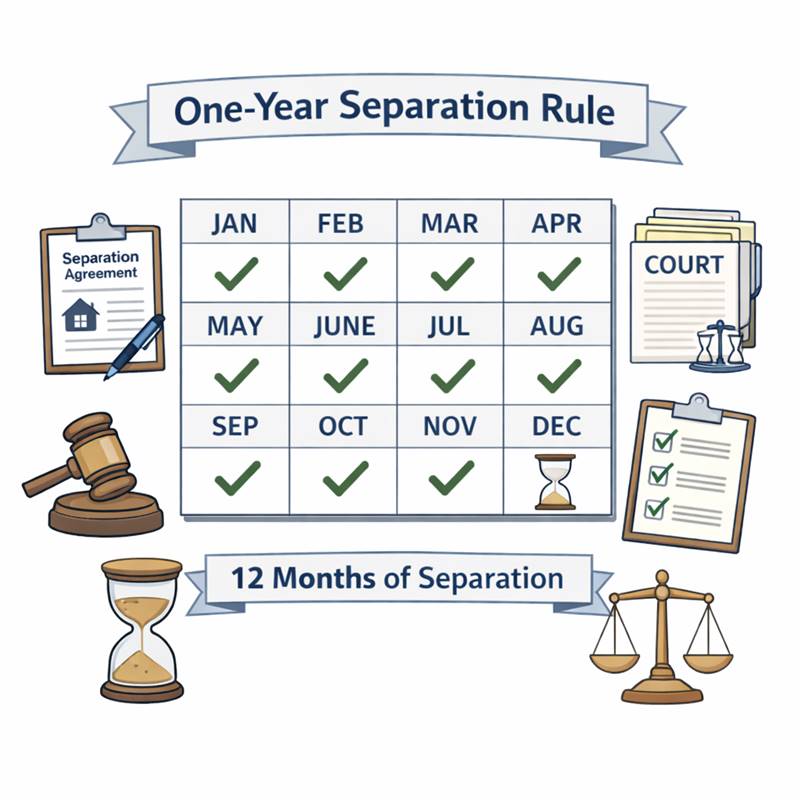
Key Takeaways
- In Ontario, most divorces are based on living separate and apart for at least one year.
- You can be separated even if you still live in the same home, depending on how you live day-to-day.
- The separation date matters because it affects divorce timing and may impact property and support issues.
- You can start divorce paperwork before the one-year mark, but the divorce usually won’t be finalized until the year is complete.
What Is the One-Year Separation Rule in Ontario?
In Ontario, the one-year separation rule means that a court can grant a divorce only after spouses have been separated for at least 12 months (one full year). In simple terms, the one-year separation rule is a timeline requirement. It does not mean you need to “wait” to start preparing. It means the court generally cannot finalize the divorce until the year has passed.
What does “separate and apart” mean in plain terms?
The legal phrase “separate and apart” does not only mean living in different houses. It means you are no longer living together as a couple.
You are generally considered separated when you stop living like spouses, meaning the relationship has ended in a real and practical way. That typically includes things like:
- No longer sharing a romantic relationship
- No longer acting like a couple socially
- No longer living as one household unit
- Having separate daily routines, responsibilities, and boundaries
A separation can begin even if you are still under the same roof, as long as your lifestyle clearly shows that the marriage has ended.
When Does the One-Year Separation Clock Start?
The separation period starts on the separation date
The separation period begins the moment the relationship changes from being a married couple to being separated spouses.
To be considered separated, you do not need to file a document or go to court right away. Separation can happen informally. The key is that the marriage has broken down in a real way, and your day-to-day life reflects that.
What is the separation date?
Your separation date is usually when one or both spouses decide the marriage is over and begin living accordingly.
It’s not always a single dramatic event. For many couples, it’s a clear turning point. For others, it happens gradually. But legally speaking, the separation date is typically the day when:
- one spouse communicates the relationship is over, and
- both spouses begin acting in a way that supports that decision
You don’t have to be fully “moved on” emotionally. You just have to be living as separated spouses rather than as partners.
Examples of what can trigger the separation date
A separation date can be triggered by different situations, depending on the couple’s reality. Common examples include:
1) Moving out
This is the simplest and most obvious scenario. If one spouse moves out of the matrimonial home and you stop living together as a couple, that date often becomes the separation date.
For example:
- One spouse moves into a new apartment on May 1
- The couple stops living together and begins separate lives
➡️ May 1 may be treated as the separation date
2) Living separately under the same roof
In Ontario, you can still be separated even if you both stay in the same home.
This often happens when:
- finances are tight
- you have children and want stability
- you need time to plan housing
- one spouse refuses to leave
In these cases, a separation date may be the day you start living independently within the home, such as:
- sleeping in separate rooms
- no longer cooking or eating together as a couple
- dividing chores and responsibilities
- keeping separate finances
- no longer attending events together as spouses
- no longer acting as a couple in front of family or friends
Even though you share an address, your relationship and household function differently.
3) Clear communication that the relationship ended
Sometimes, the separation date starts with a direct conversation. One spouse says something like:
- “I’m done. I want to separate.”
- “I don’t want to be married anymore.”
- “We’re not together anymore, even if we’re living here for now.”
If the couple then begins living separately in practice, that conversation can help establish the separation date clearly.
Do You Have to Wait a Full Year to File for Divorce?
In Ontario, you do not always have to wait a full year to file for divorce. But in most cases, you do have to wait a full year of separation before the court can grant the divorce.
Filing for divorce vs. getting a divorce order (what’s the difference?)
Many people think divorce is a single step. In reality, there are two separate stages:
1) Filing for divorce
This means starting the legal process by submitting the divorce application and paperwork to the court.
2) Getting the divorce order (finalizing the divorce)
This means the court reviews the file and officially grants the divorce once legal requirements are met.
So even if you file early, the court generally will not issue the divorce order until the one-year separation period is complete (when separation is the reason for divorce).
Can you start the process early?
Yes. In many Ontario cases, you can start the divorce process before the one-year mark as long as:
- you are already separated and have a clear separation date, and
- you are close enough to the one-year point that the process won’t finish too early
People often do this so they can:
- get paperwork prepared in advance
- avoid unnecessary delays later
- move things along once the one-year separation is reached
Why people file early (and why it can still make sense)
Filing early can be useful because divorce paperwork takes time. You may need to gather:
- marriage certificate details
- accurate dates (marriage date, separation date)
- information about children and parenting arrangements
- support and financial information (if applicable)
Starting early can prevent the situation where a couple waits a full year, then finds out they still need months to complete the court steps.
Common divorce options in Ontario
Ontario offers a few different divorce filing formats depending on whether both spouses agree and whether there are disputes.
Joint divorce
A joint divorce is when both spouses apply together. This is often the simplest option when:
- both people agree the marriage is over
- there is little or no conflict
- the paperwork can be completed cooperatively
Uncontested divorce
An uncontested divorce means one spouse files, and the other spouse does not oppose it.
This option is common when:
- the spouses agree on the divorce
- the responding spouse does not file an answer to dispute it
- the main goal is to finalize the divorce without conflict
Uncontested divorces can still involve important details, especially if there are children or support issues, but the key point is that the divorce itself is not being fought.
Sole application (divorce filed by one spouse)
A sole application is when one spouse files for divorce alone. This may happen when:
- the other spouse is uncooperative
- communication is difficult or unsafe
- the spouses are separated but not working together
A sole application can still be straightforward, but it may require more formal steps, such as properly serving the divorce documents on the other spouse.
FAQs
Do I need to be separated for one year before filing for divorce in Ontario?
Not always. In Ontario, there is a difference between filing for divorce and getting the final divorce order.
Can I be separated and still live together in Ontario?
Yes. In Ontario, you can be separated and still live in the same home, as long as you are living separate and apart in your daily life.
What is considered the official separation date in Ontario?
The separation date is usually the day spouses begin living separate and apart.
Does child support start only after the divorce is final?
No. In Ontario, child support often starts after separation, not after the divorce is finalized.
Can I date while separated in Ontario?
Yes, you can date while separated in Ontario because separation generally means the relationship has ended, even if you are still legally married.
Married Spouses in Ontario: Separation and Divorce
Key Takeaways
- Married spouses have legal rights and obligations that are different from common-law partners in Ontario.
- Marriage affects divorce, property division, and matrimonial home rights.
- Issues like child support, spousal support, and parenting arrangements can still apply after separation.
- A well-prepared separation agreement can reduce conflict and save time.
What Does “Married Spouses” Mean in Ontario?
In Ontario, the term “married spouses” refers to two people who are legally married to each other under Canadian law. This means their marriage is formally recognized, whether it took place in Ontario, elsewhere in Canada, or in another country (as long as it is legally valid).
Married spouses vs. engaged couples (Ontario)
An engaged couple is planning to get married, but engagement does not create the legal rights of marriage.
Even if a couple has been together for years, shares expenses, or has children, the engagement itself does not automatically give them the same legal protections or obligations as married spouses.
In other words:
- Engagement is a commitment
- Marriage is a legal contract with legal consequences
If an engaged couple separates, they usually won’t follow the same legal process as a married couple ending a marriage, and the legal rules around property division may be very different.
Married spouses vs. common-law partners (Ontario)
This is one of the most important distinctions in Ontario family law.
A common-law partner is someone you live within a marriage-like relationship, but without a legal marriage ceremony. Many people assume that living together long enough automatically makes them “common-law married,” but Ontario law does not treat common-law relationships the same as marriage, especially for property division.
Key differences include:
Married spouses (legally married):
- Can apply for a divorce
- Have access to equalization of net family property under Ontario’s Family Law Act (in many cases)
- Have automatic legal rules about the matrimonial home, which can create strong rights even if only one spouse owns it
Common-law partners (not legally married):
- Do not get divorced (because there is no marriage to legally end)
- Do not have automatic equalization rights the way married spouses do
- Often must rely on other claims (like unjust enrichment) for property disputes, which can be more complex and uncertain
Why legal marriage status matters in Ontario family law disputes
When a couple separates, emotions are already high. Legal confusion makes things worse.
Your status as married spouses can directly impact:
1) Whether you need a divorce to “end it” legally
Separation means you are living apart, but you are still legally married until you get a divorce.
2) Property rights and division rules
Ontario has specific legal rules for married spouses regarding division of property through the equalization process, which can affect savings, pensions, debts, and the value of assets gained during the marriage.
3) The matrimonial home
For married spouses, the matrimonial home has special protections. Even if only one spouse’s name is on title, the other spouse may still have legal rights related to possession and value.
4) Spousal support rights and responsibilities
While spousal support can apply in both married and common-law relationships, being legally married can still shape the negotiation and legal arguments, especially when combined with length of marriage, financial dependence, and other factors.
5) Court procedures and legal documents
Married couples may need separation agreements, divorce applications, and formal family court steps that don’t always apply the same way for non-married partners.
Married Spouses vs Common-Law Couples (Key Differences)
Divorce applies only to legally married spouses
If you are legally married, the only way to officially end the marriage is to get a divorce.
That means:
- You can separate today, but you remain legally married until a divorce is granted
- You may still have legal obligations as spouses even while separated
- You cannot remarry unless you are legally divorced
If you are common-law, there is no divorce process because there is no legal marriage to dissolve. Instead, the relationship ends when you separate (even though legal issues like parenting or support may still continue).
Simple way to remember it:
- Married spouses → separation + divorce
- Common-law couples → separation only (no divorce)
Property division rules are different in Ontario
This is where the difference becomes financially serious.
Married spouses (Ontario)
Married spouses can usually claim a legal right to equalization of net family property, meaning:
- The increase in value of each spouse’s property during the marriage is calculated
- The spouse with the higher increase may owe an equalization payment
This is a structured legal process under Ontario’s Family Law Act, and it often creates a clear starting point for negotiations.
Common-law couples (Ontario)
Common-law partners do not automatically share property or get equalization rights.
This means:
- Each person generally keeps whatever is in their own name
- If there is a dispute, a partner may need to pursue claims like:
- unjust enrichment
- constructive trust
- reimbursement for contributions to the other person’s property
These claims can be more difficult, more expensive to argue, and less predictable than equalization.
In practical terms:
A common-law partner may have lived in the same home and contributed financially for years, but still might not automatically be entitled to half the value in Ontario.
Matrimonial home protections apply to married spouses
Ontario law gives special treatment to the matrimonial home, which is often the most valuable asset and the most emotionally contested.
If you are married:
A home can qualify as the matrimonial home if it was the family’s primary residence at separation.
What makes this important is that married spouses may have extra protections, such as:
- Both spouses having a right to possess the home, even if only one spouse owns it
- Restrictions on selling or mortgaging the home without the other spouse’s consent in many situations
- The matrimonial home being treated differently during property division
If you are common-law:
The matrimonial home rules do not apply in the same way.
Typically:
- The partner whose name is on title often has the stronger property rights
- The non-owner partner may have to prove entitlement through court claims, rather than relying on automatic protections
Bottom line:
The matrimonial home is a major legal advantage for married spouses in Ontario that common-law partners usually don’t have.
Common-law couples may still have support and parenting rights
Even though property rules are different, common-law partners are not without legal rights in Ontario especially when children are involved.
Spousal support (common-law)
Common-law partners may still qualify for spousal support, depending on factors such as:
- length of the relationship
- financial dependence
- whether one partner supported the other’s career or earning ability
- childcare responsibilities
Spousal support is not “automatic” just because you lived together but it is possible and often negotiated in many separations.
Parenting rights (married and common-law)
Parenting rights do not depend on being married.
Both married and common-law parents can seek orders or agreements about:
- parenting time (visitation)
- decision-making responsibility
- child support
- communication schedules
- holidays and travel
When children are involved, Ontario law focuses on what supports the child’s wellbeing not the parents’ marital status.
Quick example comparison (married vs common-law outcomes)
Here’s a simple example to show how outcomes can differ.
Scenario:
A couple lived together for 10 years. They separated in Ontario. They have one child. One partner bought the home in their own name. The other partner contributed monthly to household expenses.
Outcome if they are legally married:
- They must get a divorce to end the marriage
- The spouse who does not own the home may still have matrimonial home possession rights
- They can claim equalization of property growth during the marriage
- They may be entitled to spousal support, depending on circumstances
- Parenting rights and child support still apply
✅ Result: stronger automatic legal protections for property and the home
Outcome if they are common-law:
- No divorce (relationship ends through separation only)
- The partner who is not on title may not automatically have rights to the home
- No equalization of net family property
- They may still claim spousal support (depending on facts)
- Parenting rights and child support still apply
FAQs
Can married spouses be separated but still live in the same house?
Yes. In Ontario, married spouses can be separated even while living in the same home, as long as there is a clear intention to separate and the relationship has changed in a meaningful way.
Do married spouses have to go to court to get divorced in Ontario?
Not always. Many divorces in Ontario are uncontested, meaning neither spouse disputes the divorce itself.
What is the difference between separation and divorce in Ontario?
A simple way to understand it is:
- Separation = relationship status
- Divorce = legal status
You can be separated for a long time, but you are not legally divorced until the court grants a divorce.
Do married spouses automatically split everything 50/50?
No. Ontario does not automatically divide every asset “down the middle” item by item.